Author: dfmines

Cryptocurrency News and Public Mining Pools

Portfolio to fiat without major exchange

I know a guy who knows a guy who had some luck with an alt and is thinking about taking the gains. Its 4x a decent input and while not wife changing its decently life helping. Let's say one was to sell out their bag, convert it all to a privacy token let's say for…
Read more

How Social Platform Chingari is Using Web 3.0 to Transform the Traditional Way We Use Social Media

The world is changing. This isn’t news to anyone, but sometimes it is nice to realize that—contrary to news headlines—not all the change is bad.  In fact, the last decade has seen so much innovation and so many improvements to technology that even 2015 seems like a different world.  Internet speeds, connecting with anyone globally (for free), and our ability to reach large groups of people without a middleman is nothing short of revolutionary. When it comes to technology evolution, this often happens with different iterations.  Once a system is mature, there’s a better idea of what we would like to change and improve.  We go back to the drawing board, target our creative minds at the issues, and create a new version that has evolved to better meet our needs.  The Internet has followed this model since its inception, evolving through three distinct stages.  We are only at the cusp of the third stage, called Web 3.0, with technologies such as blockchain and AI only now being capable of supporting it. A key aspect of Web 3.0 is decentralization, which nearly always involves blockchain.  To date, this has been the only way to scale a massive network efficiently and safely.   But there aren’t an abundance of social media companies who have a blockchain-based platform.  While the big players like Facebook, Instagram, and TikTok have been experimenting with blockchain, it might be impossible to swap out the massive infrastructure running these platforms today with a blockchain-based ecosystem.  That would be like wanting to swap out the foundation of a house without the people living there even noticing. To date, the social media platform Chingari is the only one to succeed in all areas:  growth (over 85 million in less than two years), a blockchain-based roadmap, and a vision for a truly decentralized ecosystem. Is Chingari the best hope for the first truly Web 3.0 social media platform?  It’s hard to say.  But to really answer the question, it’s helpful to look briefly at the key differences between Web 1.0, 2.0, and 3.0, and then to see if Chingari ticks all the required boxes for a genuine Web 3.0 platform. Web 1.0 – 2.0 Evolution, Simplified The first iteration of the Internet, later dubbed Web 1.0, spanned from its birth in the 1980’s to around 2005.  This version of the internet was marked by static websites (think of a brochure-style Geocities website) and is called the “readible” phase.  Information was displayed for others to find, but interactions such as reviews, comments, and feedback were largely absent. The second state, Web 2.0, is considered the “writable” or “social” phase because of its use of interactive data.  A key aspect is the facilitation of interactions between companies and customers, users to users, and communities.  This phase is still dominating the internet today, and encourages collaboration, being an active participant, and sharing information.  Dominating platforms are those that have a major social aspect, giving users the chance to post their own information and respond to the posts of others. The Web 3.0 Features and How Chingari Uses Them It can seem a little confusing right now because the world is dominated by Web 2.0 platforms, but there are a few pioneers who are using Web 3.0 features to transform their industries.  Chingari has a distinct advantage here for a few reasons.  As mentioned before, Web 3.0 requires a significantly improved foundation, and that is incredibly hard to change on a platform whose customers don’t accept downtime.  Chingari was launched recently enough to see the future Web 3.0 trends and build their foundation accordingly but has grown very quickly to become an established name for Web 3.0 social media.  Let’s look at five key Web 3.0 characteristics and how Chingari is using them. Feature:  Open protocols, decentralized approach (blockchain-driven) While there are ways for a platform to have an open protocol that is decentralized, only blockchain has the ability to scale and provide the necessary security to prevent hacks, takeovers, and other risks.  Chingari is built on a roadmap that will lead to an actual DAO, with the staked users helping to govern and decide the platform’s future. Feature:  Built-in business model instead of platform-driven ads (embedded ecosystem) Instead of the current social media model, where the platform works with advertisers and provides creators with a small percentage, Chingari is designed to connect marketers directly with creators.  As the platform grows using the $GARI token, Chingari will benefit as well.  However, giving significantly more power to the creators has been a key reason for the platform’s exponential growth, attracting talent and improving the quality of content as creators have a chance to actually earn a living. Feature:  Immersive experience through AI that is intuitive to user preferences, personal, and custom (consolidating content with intelligent algorithms) This feature can be seen with current Web 2.0 platforms, as this type of feature can be developed as a bolt-on service instead of replacing infrastructure.  That said, Chingari’s massive library of content would be impossible to navigate without its AI-driven recommendations and personalized curating algorithms. Feature:  Facilitates strong connections between creators and audiences (user engagement) This too can be seen by current platforms, but Chingari is using the $GARI token to allow more ways to interact with creators directly.  The platform even allows users to commit tokens into a creator pool, which returns dividends if their favorite creators continue to grow in popularity. Feature:  New ways for users to get involved and even take part in governance (smart applications) This is a broad Web 3.0 feature.  In addition to the DAO, the Chingari platform allows its creators to establish their own store, user interaction services, physical/digital/NFT marketplace, and in a very real sense to run their own business within their channel. Conclusion Until the major social media platforms find a way to convert their platforms and ecosystems to a blockchain-driven, decentralized business model, Chingari and a handful of others may become the most popular social media platforms globally.  Because Web 3.0 is a culmination of those features we have wanted to experience for the evolving internet, these are features that we have collectively stated are important to us.  And once users experience a truly decentralized platform and ecosystem, and see just how much it can enhance the creator/user experience, going back to a Web 2.0 platform will seem as antiquated and jarring as stumbling on ancient Geocities site.   Image source: Business Standard

When will the official Ethereum merch store return?

It seems that https://swag.ethereum.org/ has been down for quite some time. Before that, there was an announcement that said they couldn't fulfill orders due to COVID supply chain issues. Is there any update from the owners of this website (or from core devs) on when official Ethereum merch will return? I would love to support…
Read more

Don’t fall for this shit Elon is pulling with accepting Shib for Tesla (source coded)

For all you meme coin fanboys and girls, hearing shiba and Doge being accepted by tesla must be music to your ears. You probably are all praising Elon and worshipping him right now. Well in case you don’t realise, this same Elon is the one who is fighting against paying his fair share of taxes.…
Read more

Up to 12 Million Iranians Own Cryptocurrency, Traders Choose Local Exchanges

Cryptocurrencies are a popular investment among Iranians and estimates suggest that the number of those who already own one coin or another may be as high as 12 million. The majority of Iranian traders prefer the services of local crypto exchanges, the chief executive of one of them claims. Iranians Said to Transfer $180 Million […]

TA: Ethereum Loses Momentum, Why Bulls Could Aim Break Above $4,500

Ethereum failed to test $4,500 and corrected lower against the US Dollar. ETH is trading above $4,150 and it might attempt a fresh increase in the near term. Ethereum started a downside correction below the $4,320 and $4,250 levels. The price is now trading below $4,300 and the 100 hourly simple moving average. There is a key declining channel forming with resistance near $4,300 on the hourly chart of ETH/USD (data feed via Kraken). The pair could start a fresh increase if it stays above the $4,150 support zone. Ethereum Price Eyes Fresh Increase Ethereum failed to settle above $4,400 level and started a fresh decline. ETH price declined below the $4,320 support level to move into a short-term bearish zone. There was also a break below $4,250 and the 100 hourly simple moving average. However, the bulls appeared near the $4,150 support zone. A low is formed near $4,152 and the pair is now recovering losses. It cleared the $4,200 resistance zone. Ether is now trading above the 23.6% Fib retracement level of the recent decline from the $4,393 high to $4,152 low. An initial resistance on the upside is near the $4,250 level. The 50% Fib retracement level of the recent decline from the $4,393 high to $4,152 low is near the $4,270 level. The 100 hourly SMA is also near the $4,270 level. The next major resistance is near the $4,300 level. There is also a key declining channel forming with resistance near $4,300 on the hourly chart of ETH/USD. Source: ETHUSD on TradingView.com A close above the $4,300 level could spark a sharp increase in the near term. In the stated case, the price might rise towards the $4,400 level. Any more gains could lift the price towards the next key hurdle at $4,550. Dips Limited in ETH? If ethereum fails to continue higher above the $4,300 and $4,320 resistance levels, it could start a fresh downside correction. An initial support on the downside is near the $4,200 level. The first key support is now forming near the $4,150 level and the recent low. A downside break below the $4,150 support might push the price below the $4,100 support. The next key support is near $4,000. Technical Indicators Hourly MACD – The MACD for ETH/USD is losing pace in the bearish zone. Hourly RSI – The RSI for ETH/USD is now below the 50 level. Major Support Level – $4,150 Major Resistance Level – $4,300

The Underdogs: Under The Radar Cryptos Looking Towards Next Year

We hear and read about small cryptos and tokenized projects exploding over night, and many never hear of them weeks, days and hours before they got their success. We often wonder where these coins come from, and how many people don’t hear about them until they are mainstream. We’ll take a look at a few mid-cap cryptos that are on the radar, but have potential to become mainstays: No Need To Fear, The Underdogs Are Here Vechain  Market cap: ~$11.29B VeChain is a blockchain platform designed to enhance supply chain management and business processes. It’s goal is to streamline these processes and information flow for complex supply chains through the use of distributed ledger technology (DLT). Vechain was founded in 2015 by Sunny Lu, the former chief information officer of Louis Vuitton China. The platform started as a subsidiary of Bitse, one of China’s largest blockchain companies, and is among the few blockchains that already have a substantial customer base among established companies. Vechain has recently surged into the top 25 of largest market caps amount crypto tokens. VECHAIN: vechain currently trading at $0.13 vechain-USD on TradingView.com Related Reading | GreedSwap: Super Producers Cool And Dre Help Launch New Coin & Crypto Label More Cryptos To Keep An Eye On… StormX Market cap: ~$289M StormX is a decentralized platform where online shoppers can earn crypto in shopping rewards, with $STMX being the platform’s governance token. It is also used to store value in the upcoming line of StormX Debit Cards. The Seattle-based platform has been introducing people into the world of cryptocurrencies through a unique approach. By introducing the idea of “cashback via cryptos,” online shoppers can gain gradual exposure to cryptos by earning as they shop. This allows users to earn cryptocurrencies such as Bitcoin, Ethereum, stablecoin Dai, and also StormX’s native token. Stormx has partnered with world banks and has alot to look for in the years to come. Hedara Hashgraph Market cap: ~$4.07B Hashgraph is a distributed ledger technology that some call the alternative to blockchains; the technology is currently patented, and the only authorized ledger is Hedera Hashgraph. The native cryptocurrency of the Hedera Hashgraph system is $HBAR. The Hedera Consensus Service offers applications direct access to the native speed, security, and fair ordering guarantees of the hashgraph consensus algorithm; using this service, clients can submit messages to the Hedera public ledger for time-stamping and ordering. The platform is anticipating a mainnet upgrade next week. With about 6,000 cryptos active today, it can be difficult to draw the line between meme tokens and established tokens. Additionally, projects constantly change and grows – what’s hot today isn’t by the end of the night, but this leads to new and awesome discoveries. Related Reading DRepublic Launches World’s First Combinable NFT Platform, ‘MetaCore’ Using EIP-3664  

Who created this? I would like to use it for my #RVN Mistletoe Collection.

submitted by /u/Conclusion_Otherwise [link] [comments]

OpenSea wallet gas fee seems high .064~ ETH ($250-300)

Is this normal or should I wait to initialize my wallet? submitted by /u/xXfatboi69420tattoos [link] [comments]

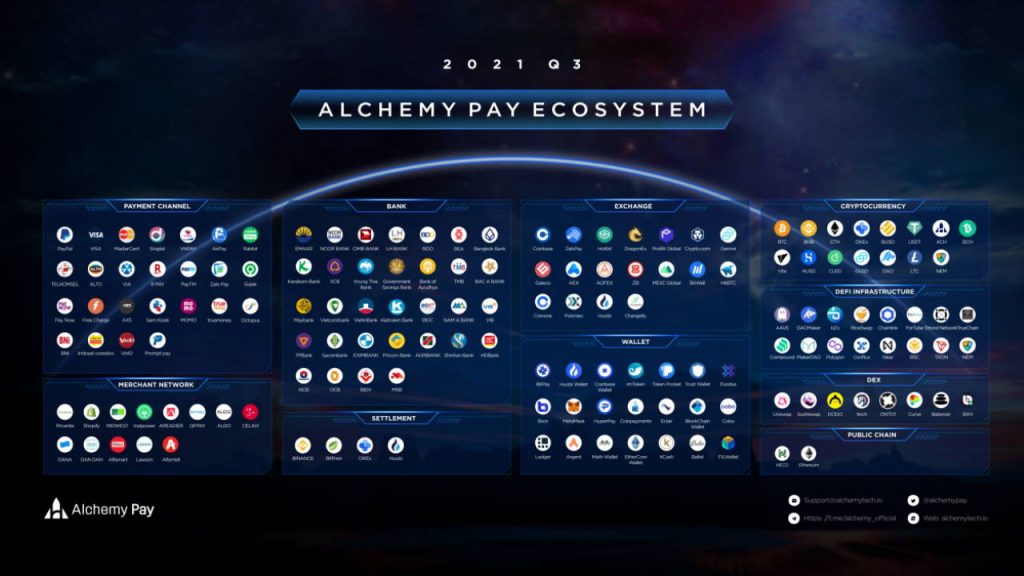
BIA Dinner: Alchemy Pay CEO John Tan Celebrates Milestones of 150 Key Nodes and 200K Supporters

Some of the premier figures in crypto gathered at the Waldorf Astoria, Shanghai on October 27th, 2021, to celebrate a new alliance with a mission to advance the blockchain industry. The Blockchain Infrastructure Alliance (BIA) was inaugurated with a dinner hosted by the crypto-fiat payment network, Alchemy Pay, alongside co-hosts Polygon Network, NEAR Protocol, Draper […]