
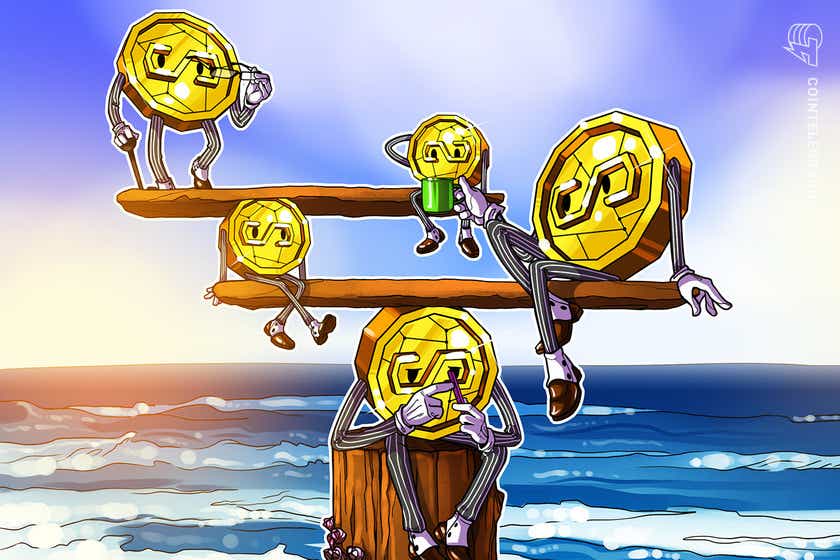
Regulators are coming for stablecoins, but what should they start with?
Regulators are coming for stablecoins, and the best place to start is with transparency standards for collateral and financial activities.
Regulators are coming for stablecoins, and the best place to start is with transparency standards for collateral and financial activities.
I'm going on a trip to the UK, the tickets I paid for with crypto. I plan on using it for everything while I'm there as well using my Coinbase card. I'm hoping I can just use that card for everything, so far so good. Going to be there for almost 2 months I have…
Read more

I’m new to crypto and took a small amount and put it on a coin I like (after a lot of reading!!) My plan is to just let it ride for a while because I really like what they are doing and think there is a lot of potential. However, the more I read about…
Read more
Hello miners, weeks ago i was able to make about 7 rvn per day with my gtx1650, i often switch between etc and rvn, after some time mining etc i was thinking about switching to rvn again, and then i saw it, not 7 rvn anymore, maybe 5-6, did someone else experience something like this?…
Read more
submitted by /u/Ok-Status6738 [link] [comments]
submitted by /u/samdane7777 [link] [comments]
For example; Kraken has the ETH2/ETH trading pair trading at ~0.96. That could be atleast +100 dollar extra ETH if you decide to buy a full coin at the current prices. submitted by /u/BromarNL [link] [comments]
In the Nexo withdrawal page it is written that "ETH withdrawals are sent from a smart contract (Bitfinex, Huobi and Hotbit do not accept ETH deposits sent from a smart contract)". ELI5, Can anyone let me know what is the difference eth sent from smart contract vs eth sent from using native chain? Can the…
Read more
Nowadays people think those times when they could find a 100x belong to the past. Let me tell you that is a completely false assumption. Investors of today miss one of the most important requirements in order to be a good investor : Patience. You see them complaining about their coin not moving for a…
Read more

Landshare is bringing real estate to the blockchain by allowing users to own real estate through tokenized assets. The tokens derive their value directly from the value of the asset and ownership of the tokens represents a real-world ownership stake in the assets. The revolutionary project presents investors a way to invest in the real estate market without having to worry about property costs, maintenance costs, or rent collection on the properties which they own. Basically, Landshare tokenizes the properties while managing the real-world properties for the benefit of its holders. How Does It Work? Landshare purchases real estate properties, which investors can own a stake in by purchasing Asset Tokens. Landshare then rents out these properties and the proceeds from rent collections are distributed to token holders monthly. When an investor purchases Asset Tokens they are purchasing a stake in a real-world property. An example of this is Landshare purchases a house somewhere. It makes sure that the house is up to standard and then rents out the house. However, unlike owning physical property, investors do not have to worry about maintenance and upkeep of the property. Landshare manages the property on behalf of the investors and as long as investors hold on to their tokens, they get paid monthly dividends from the rent being paid on the property. How Safe Is Landshare? Investments in Landshare tokens are secure and a guaranteed way to invest in the real estate market. Landshare functions similar to a REIT in that investors do not have to directly purchase any property themselves. This means that investors are not on the hook for any issues that may arise with the properties over time as the Landshare team takes care of these issues on behalf of the investors. Furthermore, Landshare tokens are secure in the fact that investors can never really lose their tokens. Unlike projects where investors lose their funds when they lose their wallets, Landshare holders can recover tokens from a lost wallet. How Do I Get Paid On Landshare? To purchase a stake in real estate through Landshare, investors only have to purchase Asset Tokens. This automatically gives the individual a portion of the ownership in the properties and makes them eligible for monthly payments. These payments, known as rental yields, are distributed on a monthly basis to Asset Token holders in the form of BUSD. The dividends are sent directly to the BSC wallet where the tokens are being held. Token holders can also stake their Landshare tokens or BUSD to earn rewards through the yield farming vaults. This enables investors to earn a yield in addition to the monthly rental yields. Landshare (LAND) Tokenomics LAND is the utility token of the Landshare platform. Their Tokenized Asset Feature allows investors to buy into the real estate assets through Landshare. The Tokenized Asset will have its own token that directly represents the value of the property. Landshare tokens have a total supply cap of 10,000,000. There are currently only 865,952 tokens in circulation as the Landshare tokens are released gradually into the market. Landshare induces scarcity to maintain the value of LAND tokens through token burns and platform fees. The deflationary nature of the digital asset makes it a prime investment option for those looking to get started in crypto and real estate. LAND tokens give holders access to the governance protocols, where they can vote on important developments in the project. Holding LAND also grants access to tokenized assets and staking vaults for earning yields.