Category: Cryptocurrency News

Cryptocurrency News and Public Mining Pools

Bitcoin Exchange Inflow Spikes, Is This Bearish?

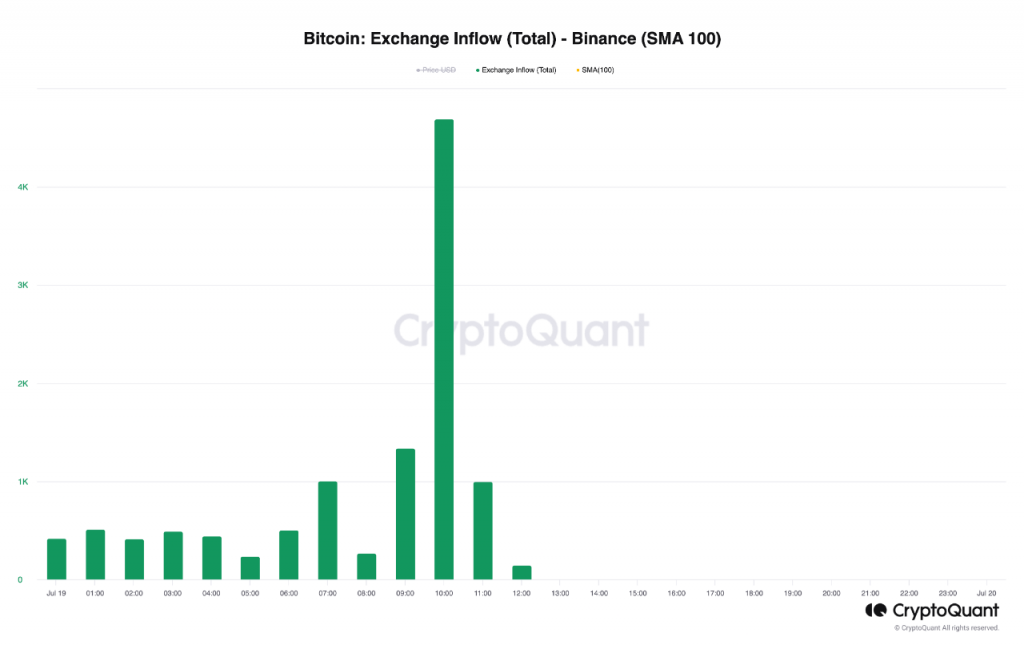
On-chain data shows the Bitcoin exchange inflow towards Binance has spiked during the past day, which may be bearish for the price. Bitcoin Exchange Inflow Has Registered A Large Spike As an analyst in a CryptoQuant post pointed out, a whale has made a large deposit to the cryptocurrency exchange Binance. The relevant indicator here is the “exchange inflow,” which measures the total amount of Bitcoin that investors send to a specific centralized exchange (which, in this case, is Binance). When the value of this metric is high, it means that the holders are depositing large amounts to the platform right now. The investors may have made these transfers for selling-related purposes, depending on which type of exchange these inflows are for. Naturally, if that is the case, the price could feel a bearish effect from the inflows. On the other hand, low values imply the exchange in question isn’t receiving that many coins currently. Such a trend would imply that the market’s selling pressure may be low. Related Reading: Bitcoin Has Broken This Open Interest Pattern, Quant Explains Now, here is a chart that shows the trend in the Bitcoin exchange inflow for the cryptocurrency exchange Binance over the past day: The value of the metric seems to have been quite high in recent hours | Source: CryptoQuant As shown in the above graph, the Bitcoin exchange inflow for Binance has observed a rather large spike in the past day. With this deposit, around 4,451 BTC (approximately worth $133 million at the current exchange rate) has entered the platform’s wallets. Interestingly, this deposit has come from a whale that has bought 20,000 BTC over the last eight months, meaning that the investor still has over 15,000 BTC left in their wallet after the transaction. The whale may have made this transfer to take some profit at the current prices. Since the scale of the deposit is quite sizeable, it could potentially cause bearish ripples in the market. However, as another quant has explained, the deposits have been towards the derivatives side of the exchange and not the spot platform. Looks like the spot exchanges inflow hasn’t moved today | Source: CryptoQuant It would appear likely that the transfer hasn’t been made to sell the coins (at least not directly) but rather for opening positions on the derivatives market. Related Reading: Signal With Perfect Track Record Predicts Bitcoin Bull Market Parabola: Analyst “This category of large wallets rarely moves directly to derivative exchanges,” notes the analyst, given that the size of the wallet in question is in the 10,000+ BTC range, the class of the largest whales on the network. Such a large position can lead to volatility in the Bitcoin price, but unlike selling from spot deposits, this price action may not necessarily be bearish for the asset. BTC Price At the time of writing, Bitcoin is trading around $29,800, down 3% in the last week. BTC has gone downhill during the last few days | Source: BTCUSD on TradingView Featured image from Kanchanara on Unsplash.com, charts from TradingView.com, CryptoQuant.com


Google Play Store officially allows NFT games, but no gambling: Nifty Newsletter, July 12–18

An on-chain tile-sliding game has been causing a massive spike in daily transactions on the Sui Network.

Apple has its own GPT AI system but no stated plans for public release: Report

The Cupertino, California-based company reportedly developed an internal GPT system on Google infrastructure for employees to tinker with.

Solidity v0.8.21 was just released!

submitted by /u/nunofilipesantos [link] [comments]

Bipartisan bill to regulate DeFi, crypto security risks, introduced into US Senate

The bill was introduced in the evening and has not been published yet, but it is already causing a stir. Crypto Twitter calls it a “nonstarter.”

OKX Wallet Introduces Staking Function For Bitcoin And BRC-20 Tokens

Cryptocurrency exchange OKX, has announced that its multichain wallet will now allow users to lock up and stake their Bitcoin (BTC) and BRC-20 tokens. This function is described as a token reward system for holders of Bitcoin and BRC-20 tokens. OKX Unveils Staking System On Multichain Wallet On Tuesday, OKX unveiled a new functionality on its multichain digital asset wallet, which enables users to stake Bitcoin (BTC) and BRC-20 tokens. According to the company’s media release, this token reward system is possible due to the integration of OKX’s open-source BRC20-S protocol.  Related Reading: Pre-Mined Ethereum Worth $116M Moves After 8 Years: Is A Major Price Dip Imminent? This protocol is an extended version of the BRC-20 standard that integrates functionalities for staking operations, like depositing, minting, and withdrawing. It allows users to earn BRC20-S tokens through the OKX Web3 DeFi aggregator. Furthermore, the BRC20-S protocol enables decentralized finance (DeFi) developers and projects to create staking pools on OKX Wallet. With these staking pools, Bitcoin holders and BRC-20 token holders can receive BRC20-S tokens. Additionally, this will help DeFi projects drive up user engagement and community-building efforts, according to OKX’s press statement. Jason Lau, OKX’s Chief Innovation Officer, claims that the wallet is the first multichain digital asset storage to support Bitcoin and BRC-20 token staking. “We have heard from OKX Wallet users that they want more opportunities to participate in the ecosystem, and we are thrilled to deliver that for them,” the CIO said. This staking capability comes as an addition to an existing host of Web3 Earn products on the OKX wallet. In the announcement, the company also mentioned the future introduction of complementary features, like a marketplace for selling BRC20-S tokens. OKX Wallet Announces Integration With Kava Blockchain In a separate announcement, OKX Wallet disclosed its partnership with Kava, an EVM-compatible blockchain built with Cosmos’ SDK (Software Development Kit). This integration will reportedly enrich the users’ options for digital asset transfer and transactions on the wallet. This represents another positive move by OKX Wallet in pursuit of maximum customer satisfaction as only a few days ago, the multichain wallet unveiled a partnership with PulseChain, another blockchain platform. Related Reading: BNB Chain Unveils Beacon Update – What’s Its Bearing On Price? Despite these positive moves and collaborations, OKB, the utility token of the OKX ecosystem, has seen a negligible market performance. According to CoinGecko data, the token’s value has only increased by 0.3% in the last 24 hours, with a 0.7% dip in the past week. As of this writing, OKB is chasing hands at $43.14, with a daily trading volume of over $2.02 million. The token has a market cap of roughly $2.59 billion, making it the 29th-largest cryptocurrency in the industry. OKBUSD trading at $43.2 | Source: OKBUSD chart from TradingView Featured image from OKX, chart from TradingView

The next bull run will begin Summer 2024

TL/DR: I 100% guarantee that Bitcoin will follow the same pattern it has it's entire existence, and there will be a bull run that starts in July 2024 at ~$25,000…ends when Bitcoin hits ~$150,000 in July 2025…and then will crash down ~$50,000 in July 2026. GUARANTEED. (dates and numbers may vary) I went ahead and…
Read more

You win the Powerball, are you sticking with crypto?

Whether they admit it or not most people are here for the money, yes the technology is transformative and has the potential to shape our futures but I imagine the majority don't use crypto outside of buying and holding it with the hopes of future gain. If you won the Powerball tonight would you buy…
Read more

Ethereum Monthly Burn Surpasses 146,000 ETH As Total Clears $6.5 Billion

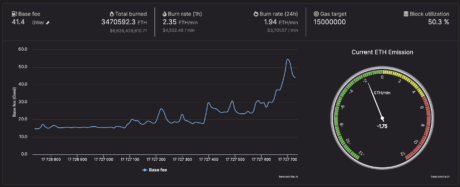
Featuring Ethereum Improvement Proposal (EIP) 1559, the London hard fork introduced significant changes to Ethereum’s transaction fee mechanism. Users now pay a base fee that is subsequently burned, effectively removing ether from circulation forever. This approach significantly impacted the token’s supply, resulting in a monthly burn rate of approximately 146,000 ETH. The London Hard Fork And Its Deflationary Impact Integrated into the Ethereum network on August 5, 2021, the London hard fork brought a paradigm shift in the cryptocurrency’s transaction fee structure. Through the EIP-1559, the network introduced a unique mechanism that involved the burning of a significant portion of transaction fees, known as the “base fee.” This innovative approach aimed to counterbalance Ethereum’s inflation while providing block rewards and priority fees to miners. Related Reading: ARK Invest CEO Says Firm Is Still Bullish On Coinbase Despite Selling COIN Stocks As a result, the base fee is permanently removed from circulation, leading to a deflationary effect on the token’s supply. The scale of the burn has been enormous, with over 3.46 million ETH, worth $6.68 billion, annihilated since the London hard fork’s enforcement. This translates to an average monthly burn rate of more than 146,000 ETH over the 710-day period that followed the upgrade. 146,000 ETH burned per month | Source: Beaconcha.in Ethereum’s deflationary path effectively offset the issuance of new tokens, curbing its supply growth by approximately 0.1% annually. Leading Contributors To The Ethereum Burn The principal factors driving Ethereum’s burn phenomenon include regular ETH transfers, non-fungible token (NFT) transactions on Opensea, and activities on the decentralized exchange Uniswap. Regular ETH transfers accounted for the most substantial reduction in supply, leading to the incineration of nearly 300,000 ETH. Uniswap v2 follows closely, with $56.5 million worth of ETH burned since the hard fork, while transfers of Tether stablecoins contributed to the destruction of $50.5 million worth of ETH. ETH price struggles to hold $1,900 support | Source: ETHUSD on TradingView.com Blockchain gaming platform Axie Infinity and Uniswap v3 each burned $32 million and $30 million worth of ETH, respectively. At the same time, the number of ETH staked in the Ethereum Beacon contract has also been on the rise. It is now sitting at over 26.87 million ETH, translating to a dollar value of $51.35 billion. Related Reading: USDC Market Cap Drops As Redemptions Climb To $1.4 Billion With the Ethereum supply sitting at 120.2 million, it means that over 11% of its supply is currently locked up while the burn continues to take coins out of circulation. Both of these developments combined could see the circulating supply of the digital asset reduce drastically, leading to a rise in the price of ETH as time goes on. ETH is currently trading at a price of $1,903 at the time of this writing, representing a 0.72% increase in the last day. Featured image from iStock, chart from TradingView.com

NFT Bro Laments That Nobody Is Buying Expensive JPGs Anymore

submitted by /u/KAX1107 [link] [comments]