Category: Cryptocurrency News

Cryptocurrency News and Public Mining Pools

Casino-Fiables Highlights the Risks of Unregulated Crypto Casinos and the Importance of Licensed Platforms

This content is provided by a sponsor. The world of cryptocurrencies has transformed numerous industries, including online gambling. As Bitcoin and other digital assets gain popularity, a new wave of crypto casinos has emerged, offering players anonymity, speed, and transactions free from banking intermediaries. They attract an ever-growing audience seeking anonymity, speed, and transactions without […]

Thailand regulator approves USDT, USDC stablecoins

The Thailand Securities and Exchange Commission (SEC) has approved Tether’s USDt (USDT) and Circle’s USDC (USDC) for cryptocurrency trades, allowing the stablecoins to be listed on regulated exchanges across the country.Thailand’s SEC announced the approvals last week after soliciting feedback from the public on proposed regulatory changes that were finalized in February and scheduled to go into effect on March 16. As Cointelegraph previously reported, there have been growing calls within Thailand to legitimize cryptocurrency usage and urge stablecoin adoption to boost domestic revenue. This followed the creation of a regulatory sandbox in August 2024 for select service providers to experiment with cryptocurrencies. The stablecoins join only five other cryptocurrencies that are approved for trading in the country: Bitcoin (BTC), Ether (ETH), XRP (XRP), Stellar Lumen (XLM) and cryptocurrencies that are being tested for settlement by the Bank of Thailand. According to a March 10 announcement by Tether, the approval allows USDt to be adopted by digital asset businesses and be used as a payment rail within the country. Related: Thailand eyes spot Bitcoin ETF approval, cracks down on PolymarketStablecoin adoption on the riseIn addition to facilitating cryptocurrency trades, stablecoins are increasingly viewed as an alternative to traditional remittances, especially in emerging markets. A December report by Chainalysis called stablecoins a “transformative” use case for cross-border payments and remittances. In emerging markets across Sub-Saharan Africa, for example, using stablecoins for remittances is 60% cheaper than traditional methods.According to venture capital firm a16z Crypto, 28.5 million unique stablecoin users sent over 600 million transactions in December alone. This still represents a tiny faction of the 3.4 trillion transactions of the global payments industry. Stablecoin transfers are significantly cheaper and faster than traditional payment methods. Source: a16z CryptoIn terms of circulating supply, stablecoins are currently worth nearly $230 billion, according to DefiLlama. Tether’s USDt accounts for just over 63% of the total market. Magazine: Ethereum L2s will be interoperable ‘within months’ — Complete guide

Emerging technology regulations: a comprehensive, evergreen approach

Opinion by: Merav Ozair, PhDTechnology is advancing at the speed of light today more than ever. We have surpassed Moore’s law — computational power is doubling every six months rather than every two years — while regulations are, and have been, playing catchup.The EU Artificial Intelligence Act just came into force in August 2024 and is already falling behind. It did not consider AI agents and is still wrestling with generative AI (GenAI) and foundation models. Article 28b was added to the act in June 2023 after the launch of ChatGPT at the end of 2022 and the flourishing of chatbot deployments. It was not on their radar when lawmakers initially drafted the act in April 2021.As we move more into robotics and the use of virtual reality devices, a “new paradigm of AI architectures” will be developed, addressing the limitations of GenAI to create robots and virtual devices that can reason the world, unlike GenAI models. Maybe spending time drafting a new article on GenAI was not time well spent.Furthermore, technology regulations are quite dichotomized. There are regulations on AI, like the EU AI Act; Web3, like Markets in Crypto-Assets; and the security of digital information, like the EU Cybersecurity Act and The Digital Operational Resilience Act.This dichotomy is cumbersome for users and businesses to follow. Moreover, it does not align with how solutions and products are developed. Every solution integrates many technologies, while each technology component has separate regulations.It might be time to reconsider the way we regulate technology.A comprehensive approachTech companies have been pushing the boundaries with cutting-edge technologies, including Web3, AI, quantum computing and others yet to emerge. Other industries are following suit in the experimentation and implementation of these technologies. Everything is digital, and every product integrates several technologies. Think of the Apple Vision Pro or Meta Quest. They have hardware, goggles, AI, biometric technology, cloud computing, cryptography, digital wallets and more, and they will soon be integrated with Web3 technology.A comprehensive approach to regulation would be the most suitable approach for the following principal reasons.A full-system solutionMost, if not all, solutions require the integration of several emerging technologies. If we have separate guidelines and regulations for each technology, how could we ensure the product/service is compliant? Where does one rule start and the other end? Recent: Animoca Brands revenue climbs as AI cuts costs by 12%Separate guidelines would probably introduce more complexity, errors and misinterpretations, which eventually might result in more harm than good. If the implementation of technologies is all-encompassing and comprehensive, the approach to regulating it should also be.Different technologies support each other’s weaknessesAll technologies have strengths and weaknesses, and often, the strengths of one technology can support the shortcomings of the other.For example, AI can support Web3 by enhancing the accuracy and efficiency of smart contract execution and blockchain security and monitoring. In contrast, blockchain technology can assist in manifesting “responsible AI,” as blockchain is everything that AI is not — transparent, traceable, trustworthy and tamper-free.When AI supports Web3 and vice versa, we implement a comprehensive, safe, secure and trustworthy solution. Would these solutions be AI-compliant or Web3-compliant? With this solution, it would be challenging to dichotomize compliance. The solution should be compliant and adhere to all guidelines/policies. It would be best if these guidelines/policies encompass all technologies, including their integration.A proactive approachWe need proactive regulation. Many of the regulation proposals, across all regions, seem to be reactions to changes we know about today and don’t go far enough in thinking about how to provide frameworks for what might come five or 10 years down the line. If, for example, we already know that there will be a “new paradigm of AI architectures,” probably in the next five years, then why not start thinking today, not in 5 years, how to regulate it? Or better yet, find a regulatory framework that would apply no matter how technology evolves.Think about responsible innovation. Responsible innovation, simplistically, means making new technologies work for society without causing more problems than they solve. In other words: “Do good, do no harm.”Responsible innovationResponsible innovation principles are designed to span all technologies, not just AI. These principles recognize that all technologies can have unintended consequences on users, bystanders and society, and that it is the responsibility of the companies and developers creating those technologies to identify and mitigate those risks.Responsible innovation principles are overarching and international and apply to any technology that exists today and will evolve in the future. This could be the basis for technology regulation. Still, companies, regardless of regulation, should understand that innovating responsibly instills trust in users, which will translate to mainstream adoption.Truth in Technology ActThe Securities Act of 1933, also known as the “truth in securities” law, was created to protect investors from fraud and misrepresentation and restore public confidence in the stock market as a response to the stock market crash of 1929. At the core of the act lie honesty and transparency, the essential ingredients to instill public trust in the stock market, or in anything for that matter. This act has withstood the test of time — an “evergreen” law. Securities trading and the financial industry have become more digital and more technological, but the core principles of this act still apply and will continue to. Based on the principles of responsible innovation, we could design a “Truth in Technology Act,” which would instill public trust in technology, internationally, now and in the future. Fundamentally, we seek these products and services to be safe, secure, ethical, privacy-preserving, accurate, easy to understand, auditable, transparent and accountable. These values are international across regions, industries and technologies, and since technology knows no boundaries, neither should regulations.Innovation may create value, but it may also extract or destroy it. Regulation helps limit the latter two types of innovation, while well-designed regulation may enable the first kind to survive and flourish. A global collaboration may find ways to incentivize innovation that creates value for the good of the global economy and society.It might be time for a Truth in Technology Act — an international, comprehensive, evergreen regulation for the good of the citizens of the world.Opinion by: Merav Ozair, PhD. This article is for general information purposes and is not intended to be and should not be taken as legal or investment advice. The views, thoughts, and opinions expressed here are the author’s alone and do not necessarily reflect or represent the views and opinions of Cointelegraph.


South Korea Pushes for a Bitcoin Reserve. Could $BTCBULL Presale Benefit?

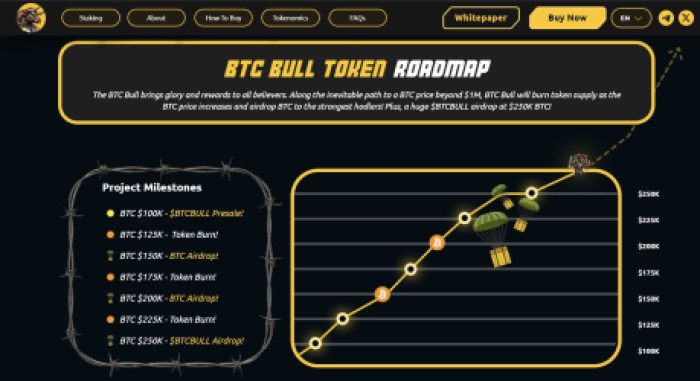
The South Korean Democratic Party has called for the formation of a Bitcoin reserve in their country as a response to Trump’s announcement of a US Bitcoin reserve. With nations racing to hoard Bitcoin, the price of $BTC can only rally.  If you want to get in on that action, it could be worth checking out a meme coin designed to ride on Bitcoin’s coattails, BTC Bull Token ($BTCBULL). South Korea Takes Cue from the US Just two days back, Trump signed an executive order to set up a Bitcoin reserve in the US, calling it the ‘digital Fort Knox for digital gold.’ He also laid down the country’s plan to build a stable pile of the best altcoins. As expected, this has started a global crypto race, and South Korea is among the first countries to hop on the bandwagon. South Korea’s quick response is surprising, considering it’s been slow in adopting and regulating cryptocurrencies. For instance, non-residents aren’t allowed to trade on South Korean crypto exchanges, and crypto ETFs are still banned in the country. After playing catch-up for so long, South Korea appears to be on a drive to take its place in the new crypto world order. Kim Jong-Seung, CEO of blockchain firm Crypton, said it’s about time the South Korean government thinks about a Won-pegged stablecoin and develops a model to link these with dollar stablecoins. He warned that South Korea might lose ‘monetary sovereignty’ if USD-pegged stablecoins become a staple in the industry. Japan Relaxes Rules for Crypto Brokerages Japan, on the other hand, has been working aggressively to keep pace with the global crypto race. The country has introduced an amendment bill that lets crypto companies work as intermediaries. This means they no longer require the same kind of licenses as crypto exchanges and crypto wallet operators do. Stablecoin issuers will also be able to use Japanese and US government bonds to back their coins. Earlier, these issues had to maintain cash deposits in bank accounts in a ratio of 1:1 to the total amount of tokens in circulation. However, issuers can now use bonds to back just 50% of this amount, while the rest will be held in cash. Crypto brokerages will also be relieved from the application of anti-money laundering regulations, which will reduce the barrier to entry. There are also talks of reducing the tax on crypto from 55% to 20%. Quite clearly, Trump has sent a lot of nations into a frenzy with talks of the US Bitcoin reserve, which should all ultimately benefit the underlying asset, i.e., Bitcoin. After all, there can hardly be a price mover bigger than the support of the world’s governments themselves. If you, too, want to benefit from the mounting global interest in Bitcoin, read on for more about Bitcoin’s official meme coin, BTC Bull Token ($BTCBULL). What Is BTC Bull Token? BTC Bull Token is a one-of-a-kind meme coin offering real (and free) Bitcoin every time $BTC reaches a new milestone, such as $150K, $200K, $250K, and so on. This gives you a unique opportunity to ride Bitcoin’s upcoming rallies without actually investing a hefty sum of money. That said, you’d need to buy and hold $BTCBULL in Best Wallet to be eligible for the $BTC airdrops. With all the regulatory support Bitcoin has been getting recently, and seeing as it’s quite literally synonymous with crypto, it’s highly likely it’ll keep making higher highs for the next few years. The more Bitcoin soars (analysts say it can go to $150K in just this year), the more airdrops you’ll get. What’s more, the developers have also kept 40% of the total token supply for marketing and PR to boost the token’s popularity and build a strong and dedicated community of $BTCBULL investors. So, there’s a high chance $BTCBULL will remain a trending meme coin for a long period of time. Plus, there’ll be periodic token burn events to manage supply. This will create scarcity, leading to higher demand and, in turn, a higher token value. Why Should You Buy $BTCBULL? Who doesn’t want to own Bitcoin? After all, it’s the most sought-after crypto in the world. It’s digital gold. Several analysts have predicted targets of even $1M for the token. However, not everyone has the kind of money to buy enough $BTC that the upcoming price jump will make them a fortune. After all, 1 $BTC is currently priced at $81,520. With $BTCBULL, you stand to benefit from Bitcoin’s growth in two ways: You get free $BTC via airdrops Since BTC Bull Token’s price will rise alongside Bitcoin’s, you’ll see a huge appreciation in your initial investment into this crypto presale. Thanks to its unmatched appeal to Bitcoin maximalists, the BTC Bull Token presale has been a raging success. Less than a month since its launch, it has already raised over $3.46M. Each token is currently available at a low price of $0.002405. With the next price increase set to take place in just a few hours, this might be your last chance to buy $BTCBULL for so cheap. Check out $BTCBULL’s whitepaper and X feed for more information. That said, investments in the crypto market can be risky and require a proper understanding of risk management practices. This article isn’t financial advice, and we urge you to do your own research before putting your hard-earned money into crypto.

IPMB report: The first vertically integrated gold tokenization project

As the global demand for gold remains strong and the asset’s price has reached all-time highs, investors face a difficult choice between various gold investment vehicles. Traditional methods for investing in gold come with a number of drawbacks. Physical gold incurs substantial buy and sell fees, gold futures require advanced financial literacy, while gold-backed cryptocurrencies often lack reliable reserve audits, or their sources of gold are opaque.IPMB: bringing together gold and cryptocurrencyThe International Precious Metals Bullion Group (IPMB) combines vast experience in the gold industry with opportunities provided by blockchain technology to offer a novel approach to gold investing that is reliable and cost-efficient. By controlling the crucial steps of the supply chain, IPMB offers favorable pricing and transparency for investors in its gold-backed GoldPro Token (GPRO) and GEM NFTs. A recent report published by Cointelegraph provides insight into this precious metals project. It gives an overview of the challenges gold tokenization solutions face, from physical gold issues to providing liquidity and backup guarantees for digital tokens. The report discusses an in-house solution developed by IPMB to track the gold supply chain, its GPRO token fully collateralized by gold, and the gold-backed GEM NFTs. The report concludes with an overview of the IPMB ecosystem and its future development plans.                       To learn how IPMB manages the entire supply chain and tokenization of gold, download a full version of the report for free hereInefficiencies in the gold marketThe supply chain for physical gold relies on multiple intermediaries, which results in price premiums that are ultimately borne by investors. Furthermore, physical gold investments incur premiums at purchase and come with substantial buy/sell spreads, as well as custody fees of up to 1% per year. (Figure 1).In addition to increased costs, complex gold supply chains make it easier to disguise the origin of gold ore and hide unethical mining. For instance, Ghana, a leading gold producer, has faced criticism for unregulated artisanal mining, which harms the environment and often infringes on human rights.Streamlining the gold supply chainIn contrast to most existing gold tokenization solutions that rely on third-party supplies, IPMB co-owns gold mining facilities in Ghana and controls the entire gold ore delivery process. As a result, IPMB eliminates unnecessary intermediaries and achieves transparency and sustainability for the whole supply chain.  The forthcoming launch of the Goldtrace360, an in-house tracking solution designed by IPMB, will automate the tracking process and significantly reduce latency. Goldtrace360 will utilize IoT technologies to record every step in the gold production process on the blockchain.To learn how IPMB manages the entire supply chain and tokenization of gold, download a full version of the report for free hereIntroducing gold-backed GEM NFTsGEM NFTs are digital promissory notes IPMB offers for investment grade 24-karat gold. GEM NFTs are ownership titles for gold bars on the Polygon blockchain. They range from 1 gram to 12,500 grams to cater to a wide range of potential investors.GEM NFTs can be obtained by staking GPRO, the native token of the IPMB ecosystem on the Polygon blockchain. While GPRO tokens are 1:1 backed with gold, their price remains free-floating.To obtain an NFT of a specific denomination with a discount, the user must stake a corresponding number of GPRO tokens for a period of between three and 12 months. Longer staking is rewarded with a higher discount. If 100 GPRO tokens are staked for 12 months, 89 GPRO will be converted into a GEM NFT and 11 GPRO will be returned to the user. A limited number of NFTs are allocated to staking each month (Figure 2).If the user triggers GPRO to GEM NFT conversion at the end of the staking period, GPROs get burned. At the same time, the GEM NFT gets assigned a unique 24-karat gold coin or bar and a London Bullion Market Association (LBMA) serial number, which is also reflected in the NFT metadata.GEM NFTs that are at least one year old can be redeemed for physical gold, and the redemption is free of charge for NFTs of over 100 grams of gold in denomination. If not redeemed, NFTs stay free of insurance, custody or management fees for the first five years following the mint date.To learn how IPMB manages the entire supply chain and tokenization of gold, download a full version of the report for free hereThis article does not contain investment advice or recommendations. Every investment and trading move involves risk, and readers should conduct their own research when making a decision.This article is for general information purposes and is not intended to be and should not be taken as legal or investment advice. The views, thoughts, and opinions expressed here are the author’s alone and do not necessarily reflect or represent the views and opinions of Cointelegraph.Cointelegraph does not endorse the content of this article nor any product mentioned herein. Readers should do their own research before taking any action related to any product or company mentioned and carry full responsibility for their decisions.

Will Shiba Inu Reclaim $0.000012? SHIB Eyes Retest After Key Support Breakdown

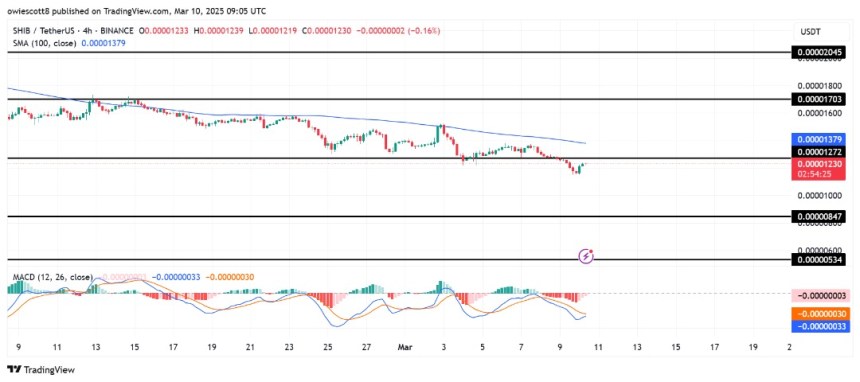
Shiba Inu is at a make-or-break moment as it struggles to recover from a recent support breakdown. The price drop has shaken bullish sentiment, raising concerns about further losses if buyers fail to regain control. Now, SHIB eyes a potential comeback, aiming to reclaim the $0.00001272 level, which has turned into a key resistance zone. Buying momentum must increase for a rebound to gain traction, pushing SHIB above this crucial barrier. However, if bearish pressure persists, the price could face another downward move, leading to deeper losses.  SHIB Loses Crucial Support Shiba Inu recently faced a significant setback as its price broke below the critical support level of $0.00001272. This level had previously acted as a strong floor, providing stability during market volatility. However, increasing selling pressure and bearish market sentiment pushed SHIB below this key threshold, signaling a potential shift in momentum. Related Reading: Shiba Inu Price To $0.000045? Here Are The Major Support And Resistances To Watch Out For Following the breakdown below the $0.00001272 support level, SHIB is attempting to retest this crucial zone. For SHIB, reclaiming this level might signal a reversal, restoring confidence among investors. Nonetheless, failure to break back above $0.00001272 may reinforce bearish momentum, leading to further declines. Despite the ongoing retest attempt, technical indicators reveal weak bullish momentum, raising concerns about SHIB’s ability to recover. The MACD line and the signal line remain below average. Additionally, SHIB continues to trade below the 100-day SMA, reinforcing seller dominance. However, if the bulls manage to push SHIB’s price above the $0.00001272 resistance level and reclaim the 100-day Simple Moving Average (SMA), it could signal a trend reversal. A successful breakout above these key levels may attract renewed buying interest, strengthening upside movements to challenge higher resistance levels such as $0.00001703 and $0.00002045. Downtrend Concerns: Will Shiba Inu Face More Losses? Shiba Inu remains under bearish pressure, sparking doubts about this current bullish recovery. With SHIB trading below key resistance levels and the MACD signaling weakness, sellers currently have the upper hand. Failure to break above the $0.00001272 resistance zone could accelerate losses, pushing SHIB toward lower price levels. Related Reading: Shiba Inu Targets Fresh Highs As SHIB Undergo A Rebound At $0.00002045 If this scenario unfolds, SHIB is likely to test the $0.00000847 support level. Breaking below this key zone may trigger an extended sell-off, potentially pushing the price toward the $0.00000534 support area.  Such a drop could indicate growing bearish dominance, shaking investor confidence, and leading to increased selling pressure. For SHIB to avoid deeper losses, buyers must step in at these crucial levels and prevent the meme coin from entering a prolonged downtrend phase. Featured image from Adobe Stock, chart from Tradingview.com

Bitcoin may benefit from US stablecoin dominance push

The US push to maintain the dollar’s global dominance through stablecoin adoption could have unintended benefits for Bitcoin as it emerges as a potential national reserve asset.During the White House Crypto Summit on March 7, US Treasury Secretary Scott Bessent said the American government would use stablecoins to ensure the US dollar remains the world’s global reserve currency.“We are going to put a lot of thought into the stablecoin regime, and as President Trump has directed, we are going to keep the US [dollar] the dominant reserve currency in the world,” Bessent said.The treasury secretary also repeated the Trump administration’s promise to end the war on crypto and committed to rolling back previous Internal Revenue Service guidance and punitive regulatory measures.President Trump delivers address to White House Crypto Summit. Source: The Associated PressThe comments came just before Trump signed an executive order establishing a Bitcoin (BTC) reserve using cryptocurrency forfeited in government criminal cases. While the order does not involve direct federal Bitcoin purchases, it represents a shift in how the government views the cryptocurrency.Bitcoin may benefit from the growing stablecoin adoption and push for more regulatory clarity, according to Omri Hanover, general manager at the Gems Trade blockchain launchpad. “If Trump’s policy strengthens US financial dominance, Europe’s reluctance and ‘wait-and-see’ approach could weaken its economic leverage,” he told Cointelegraph, adding:“This divide creates two market realities: US accelerates Bitcoin’s institutional adoption, drawing capital; and EU prioritizes compliance, risking a capital shift to US markets.”Meanwhile, two major bills await congressional approval: the Stablecoin bill and the Market Structure bill, which aim to help lift the regulatory uncertainty around the US crypto industry.Meanwhile, pro-crypto lawmakers have focused on two major legislative priorities — stablecoins and general market structure clarity — which would help lift the regulatory uncertainty around the US crypto industry. However, no related bills have yet been passed by Congress.Related: US Bitcoin reserve marks ‘real step’ toward global financial integrationGrowing stablecoin issuer profits may flow into Bitcoin investmentsThe growing profits of stablecoin issuers could contribute to Bitcoin investments, further strengthening its status as a store of value.Tether, the issuer of the world’s largest stablecoin, USDt (USDT), said it would invest 15% of its net profit into Bitcoin to diversify its backing assets.Tether’s Bitcoin holdings proved to be lucrative when the firm posted a record $4.5 billion profit for the first quarter of 2024.Approximately $1 billion stemmed from operating profits derived from US Treasury holdings, while the remaining $3.52 billion comprised the market-to-market gains in the firm’s Bitcoin holdings and gold positions.Tether’s financial reserves, Q1 2024. Source: TetherRelated: Paolo Ardoino: Competitors and politicians intend to ‘kill Tether’Tether’s “bc1q” address currently holds over $6.8 billion worth of Bitcoin, making it the world’s sixth-largest holder, BitInfoCharts data shows.Tether’s Bitcoin holdings earned the company $5 billion in profits during 2024, out of its total $13 billion yearly profit, Cointelegraph reported on Jan. 31.Magazine: Bitcoin’s odds of June highs, SOL’s $485M outflows, and more: Hodler’s Digest, March 2 – 8

Strategy Gears up to Buy the Bitcoin Dip With Fresh $21B Stock Offering

Strategy is seizing the market downturn, unveiling a $21 billion stock offering to buy the dip on bitcoin, reinforcing its aggressive treasury strategy despite volatility. Strategy Prepares to Buy the Bitcoin Dip Software intelligence firm Microstrategy (Nasdaq: MSTR), now operating as Strategy, announced on March 10 that it has launched a $21 billion at-the-market (ATM) […]

DeFi TVL drops by $45B, erasing gains since Trump election

The total value of cryptocurrencies locked (TVL) in decentralized finance (DeFi) protocols has lost all its gains since Donald Trump was elected US president in November 2024.Following the US election, DeFi TVL rose to as high as $138 billion on Dec. 17, but had retracted to $92.6 billion by March 10, as noted by analyst Miles Deutscher.Solana has borne the brunt of criticism as its memecoin popularity fades, but Ethereum has faced its own challenges in recent cycles, with Ether (ETH) failing to reach a new all-time high despite Bitcoin (BTC) soaring past $109,000 on Jan. 20, the day Trump took office. Ethereum’s TVL has also dropped by $30.6 billion from cycle highs, DefiLlama data shows.Source: Miles DeutscherEther’s record high price of $4,787 from November 2021 remains unbroken despite positive industry developments, such as spot exchange-traded funds (ETFs) launching in the US and Trump’s executive order for a strategic Bitcoin reserve.Related: Bitcoin risks weekly close below $82K on US BTC reserve disappointmentEthereum’s $1.8 billion weekly net exchange outflowNearly 800,000 ETH, worth approximately $1.8 billion, left exchanges in the week starting March 3, resulting in the highest seven-day net outflow recorded since December 2022, according to IntoTheBlock data.The outflows are unusual given Ether’s 10% price decline during the period, hitting a low of $2,007, per CoinGecko. Typically, exchange inflows signal selling pressure, while outflows suggest long-term holding or movement into decentralized finance (DeFi) applications, such as staking or yield farming.“Despite ongoing pessimism around Ether prices, this trend suggests many holders see current levels as a strategic buying opportunity,” IntoTheBlock stated in a March 10 X post.Before March 3, Ethereum experienced net exchange inflows daily, indicating that investors were selling during the downturn, said Juan Pellicer, senior research analyst at IntoTheBlock, in comments to Cointelegraph. He noted that ETH’s drop to $2,100 may have triggered accumulation, which then led investors to withdraw funds from exchanges.Pectra upgrade meets own road bumpsEthereum’s rollup-centric roadmap has reduced congestion and gas fees but introduced liquidity fragmentation.The upcoming Pectra upgrade aims to address this by enhancing layer-2 efficiency and interoperability. By doubling the number of blobs, it reduces transaction costs and helps consolidate liquidity. Additionally, account abstraction allows smart contract wallets to function more seamlessly across Ethereum and layer-2 networks, simplifying bridging and fund management.The Pectra upgrade rollout encountered setbacks on March 5 when it launched on the Sepolia testnet. Ethereum developer Marius van der Wijden reported errors on Geth nodes and empty blocks being mined due to a deposit contract triggering an incorrect event type. A fix has been deployed.Magazine: Pectra hard fork explained — Will it get Ethereum back on track?

Best Meme Coins to Buy as Large Whale Buying Hints at an Upcoming Litecoin Rally

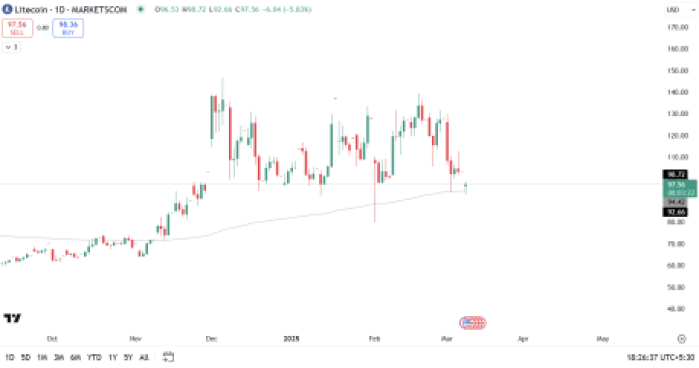
A cheaper and faster blockchain network, Litecoin is widely used for payments and remittances, as well as a store of value. Great news for Litecoin investors is that institutional investors have jumped in big time. Considering ‘smart money’ is what really moves the market, Litecoin is poised for a strong upmove. Analyst Ali Martinez took to X to inform crypto enthusiasts that whales bought over $43M worth of $LTC in just two days. Ali also pointed towards Litecoin’s chart, saying that its current trading inside a broad range, and a strong hold above $98 could see the token fly to $135. Additionally, we can also see $LTC taking support at the 200 EMA (exponential moving average), which further confirms its bullish outlook. With top cryptocurrencies like $LTC, $BTC, $ADA, and $ETH spiking investor interest – Trump just announced strategic crypto reserves for Bitcoin and other tokens, for instance – the market looks ripe for a huge rally. To help you make the most of it, we’ve highlighted a few tokens with the potential to 100x your investment. 1. BTC Bull Token ($BTCBULL) – Best Crypto to Ride Bitcoin’s Growth Although a meme coin at its heart, BTC Bull Token‘s interesting fundamentals make it one of the best cryptos to invest in. After all, it’s the ONLY crypto project whose token holders will be rewarded with free $BTC. Every time Bitcoin hits a new price landmark, such as $150K, $200K, $250K, and beyond, BTC Bull Token developers will automatically send real $BTC to $BTCBULL token holders. The only requirement is that these tokens must be stored in Best Wallet. Not only that, but the fact that these Bitcoin airdrops are directly tied to the $BTC’s price makes BTC Bull Token ideal for those looking for a low-cost way to invest in Bitcoin’s historic growth. The project will also follow a deflationary model, wherein the total token supply will be artificially reduced at periodic intervals. Combined with a heavy focus on marketing, i.e., maintaining market hype, BTC Bull Token could easily be the next crypto to explode. You can join the BTC Bull Token presale ($3.4M+ raised) by shelling out just $0.002405 per token. 2. Solaxy ($SOLX) – Top Meme Coin with Real Utility Although a hub for meme coin development and trading, Solana ($SOL) has lately been struggling to keep up with the increasing demand. The network has been overwhelmed, which is why it’s been coughing up frustrating outages and sustainability issues. Solaxy ($SOLX) is set to be Solana’s knight in shining armor. Or the princess who kisses the frog (in this case Solana) to turn it into the prince that it really is. That’s because Solaxy plans to build Solana’s first Layer-2 chain. By processing transactions off-chain, Solaxy will significantly reduce the pressure on Solana’s mainnet. This will better equip it to manage increased demands during traffic surges, such as the one it faced during the launch of $TRUMP in January. The Solaxy presale, with over $25.7M in its kitty, is already among the best crypto presales of the year. However, it’s now gaining noticeable momentum because Solana validators are about to vote on two critical upgrade proposals this month. These upgrades could result in a strong upside momentum for $SOL. This would then also have a positive impact on $SOLX’s price. Currently, 1 $SOLX is available for only $0.001658. Here’s how to buy it. 3. Catslap ($SLAP) – Listed Meme Coin with a Slap-to-Earn Model Catslap ($SLAP) might not have a rock-solid purpose like the above tokens, but it’s proof that it doesn’t have to make sense to make you money. Based on the viral ‘slapping cat’ meme, Catslap ($SLAP) follows a one-of-a-kind slap-to-earn model. The rules are simple: token holders pick their favorite (or rather least favorite) real-life character, like Elon Musk and Donald Trump. And then slap them like there’s no tomorrow. Those who manage to channelize their inner strength and make it to the list of the top 10 slappers stand to make real cash – up to a whopping $10K each. Although $SLAP‘s price has been in the red ever since it rose by over 45% in the first week of January, there are a few reasons to be optimistic about this token’s future. The Catslap team will continue to hold 10% of the total token supply for the next 10 years. This shows their confidence in the project. There are regular token burn and buyback events, both of which are typically associated with a price increase. You can invest in possibly one of the best meme coins for just $0.0005694 per token. 4. Fartcoin ($FARTCOIN) – Solana Crypto Poised to Make a Comeback Fartcoin initially gained traction for its nonchalant nature. The very idea of being able to earn free tokens by submitting fart jokes is so absurd it’s brilliant. Add to that the amusement of hearing a fart sound every single time you make a transaction on the platform. And you get a coin that had a +480,000% historical performance in five months. It wasn’t long ago that $FARTCOIN was sailing high, touching new highs every week. It reached its all-time high of around $2.4 in the third week of January. But it has since then lost almost 90% of its value. It’s currently trading at $0.2369. However, a surge of nearly 16% in a single day might just be the first sign of the resurrection of Solana’s OG meme coin. The token’s recent price jump came on the back of the White House ‘Crypto Summit.’ This clearly shows that the token has the potential to rally come a new crypto bull run. Moreover, with big-time crypto traders like Altcoin Sherpa and Unipcs backing Fartcoin to go to the moon, it could prove to be an excellent high-risk/high-reward situation. Bottom Line Although we’ve had several pieces of positive news about multiple big cryptos, like Bitcoin, Solana, and Litecoin, we’re still a few knots away from an out-and-out bull run. This means you can’t just get in and get out as you would in a trending market. So, invest carefully, including putting in only a reasonable sum of money. Additionally, none of the above is a substitute for financial advice. You must always do thorough firsthand research before investing.