
Category: Cryptocurrency News

Cryptocurrency News and Public Mining Pools

Web3 devs, gamers, investors thrive despite India’s crypto policy hurdles

India’s contribution to the global Web3 ecosystem — primarily in software development, gaming, investments and startup funding — increased year-on-year despite an absence of locally tailored crypto regulations.India’s share of global Web3 developers grew from 5% to 12% in the last 10 years, second only to the United States as of 2024, according to the India Web3 Landscape Report 2024 by Hashed Emergent, shared with Cointelegraph.Developer growth in India since 2015. Source: Hashed EmergentSpeaking to Cointelegraph, Tak Lee, CEO and Managing Partner at Hashed Emergent, pointed out four key factors driving India to the top of global crypto adoption: retail crypto transactions on centralized services, highest trading volumes, institutional adoption and retail DeFi transactions.Gen Z dominates the Web3 developer landscape in IndiaThe growth is driven by the younger generation, as roughly 80% of all blockchain developers in India are between 18 and 27 years of age. The Indian developers in DeFi, Payments, AI and SocialFi prefer Solana as the go-to blockchain.Ton, Aptos and Base are steadily gaining momentum across other key sectors, driven by the expanding presence of layer-1 and layer-2 ecosystems, the report noted.Web3 sector and ecosystem trends in India. Source: Hashed EmergentWhile funding opportunities and builder initiatives like hackathons support initial growth, Indian developers have pointed out employers’ lack of willingness to pay salaries that match global industry standards. The challenges faced by Web3 gaming projects are the extremely high cost of customer acquisition (CAC) to onboard Web3 users and the lack of quality gameplay beyond financial incentives to retain Web2 gamers. “Therefore, several of these games are now focusing on having great quality games before integrating blockchain mechanics or tapping into Indian gamers’ craze for RMG,” Lee explained.Related: Indian town adopts Avalanche blockchain for tamper-proof land recordsIn contrast, investments into the Indian Web3 landscape saw a 224% increase in 2024 compared to the previous year — sourced from various avenues such as local funds, ecosystem funds and corporate venture arms of leading exchanges.Lee told Cointelegraph that the lack of growth capital in the Web3 world, along with the absence of traditional venture/growth/private equity funds, makes it difficult for Indian firms to raise capital, adding:“Therefore, entrepreneurs explore crowd sales as a way to fund their future growth. Some renowned projects may also explore crowd sales due to higher valuations offered but this is extremely rare and done by the extremely blue chip founders who can raise money from retail with ample certainty and high volumes.”Funding in India’s Web3 finance sector. Source: Hashed EmergentCompared to the previous years, the substantial growth in Web3 investments in 2024 “signals a gradual recovery, with investors focusing on emerging areas of decentralized finance,” the report said.India is a global hub for founders and developers, currently home to the second-largest developer market and third-largest founder base globally. Some of the main barriers preventing large-scale investments, according to Tak, have to do with the “slower than anticipated growth of some of these startups .“ Unclear regulations and compliances also hinder Web3 investments in India. Growing Web3 against all oddsDespite an active high-tax environment on cryptocurrency, small-scale crypto investments saw an uptick in India. Traders generally preferred small, frequent trades, with 96% maintaining positions less than $12 with an average of 11x-20x leverage. Females represented 1 in 10 futures traders in India, highlighting the scope for greater participation. The report called for reforms in crypto tax deductions and reporting in addition to the need for federal guidance and tax implications:“India must overcome its negative policy perception that stifles innovation and instead focus on identifying and addressing the pain points faced by stakeholders with effective regulation that will incentivize the Web3 sector to grow and thrive.”Indian Web3 firms call for progressive regulation for all stakeholders. Source: Hashed EmergentThe policy wish list for the Indian Web3 includes the regulatory framework for virtual asset service providers (VASP), tax rationalization, streamlined banking and payment access for Web3 companies, exemptions from VASP regulations and clarity on existing regulations.Recent regulatory initiatives like URL blocking of locally unlicensed crypto exchanges have resulted in the influx of funds to self-custodial solutions (decentralized exchanges) or domestic exchanges, which are regulated under Indian law.Magazine: Mystery celeb memecoin scam factory, HK firm dumps Bitcoin: Asia Express
Web3 devs, gamers, investors thrive despite India’s crypto policy hurdles

India’s contribution to the global Web3 ecosystem — primarily in software development, gaming, investments and startup funding — increased year-on-year despite an absence of locally tailored crypto regulations.India’s share of global Web3 developers grew from 5% to 12% in the last 10 years, second only to the United States as of 2024, according to the India Web3 Landscape Report 2024 by Hashed Emergent, shared with Cointelegraph.Developer growth in India since 2015. Source: Hashed EmergentSpeaking to Cointelegraph, Tak Lee, CEO and Managing Partner at Hashed Emergent, pointed out four key factors driving India to the top of global crypto adoption: retail crypto transactions on centralized services, highest trading volumes, institutional adoption and retail DeFi transactions.Gen Z dominates the Web3 developer landscape in IndiaThe growth is driven by the younger generation, as roughly 80% of all blockchain developers in India are between 18 and 27 years of age. The Indian developers in DeFi, Payments, AI and SocialFi prefer Solana as the go-to blockchain.Ton, Aptos and Base are steadily gaining momentum across other key sectors, driven by the expanding presence of layer-1 and layer-2 ecosystems, the report noted.Web3 sector and ecosystem trends in India. Source: Hashed EmergentWhile funding opportunities and builder initiatives like hackathons support initial growth, Indian developers have pointed out employers’ lack of willingness to pay salaries that match global industry standards. The challenges faced by Web3 gaming projects are the extremely high cost of customer acquisition (CAC) to onboard Web3 users and the lack of quality gameplay beyond financial incentives to retain Web2 gamers. “Therefore, several of these games are now focusing on having great quality games before integrating blockchain mechanics or tapping into Indian gamers’ craze for RMG,” Lee explained.Related: Indian town adopts Avalanche blockchain for tamper-proof land recordsIn contrast, investments into the Indian Web3 landscape saw a 224% increase in 2024 compared to the previous year — sourced from various avenues such as local funds, ecosystem funds and corporate venture arms of leading exchanges.Lee told Cointelegraph that the lack of growth capital in the Web3 world, along with the absence of traditional venture/growth/private equity funds, makes it difficult for Indian firms to raise capital, adding:“Therefore, entrepreneurs explore crowd sales as a way to fund their future growth. Some renowned projects may also explore crowd sales due to higher valuations offered but this is extremely rare and done by the extremely blue chip founders who can raise money from retail with ample certainty and high volumes.”Funding in India’s Web3 finance sector. Source: Hashed EmergentCompared to the previous years, the substantial growth in Web3 investments in 2024 “signals a gradual recovery, with investors focusing on emerging areas of decentralized finance,” the report said.India is a global hub for founders and developers, currently home to the second-largest developer market and third-largest founder base globally. Some of the main barriers preventing large-scale investments, according to Tak, have to do with the “slower than anticipated growth of some of these startups .“ Unclear regulations and compliances also hinder Web3 investments in India. Growing Web3 against all oddsDespite an active high-tax environment on cryptocurrency, small-scale crypto investments saw an uptick in India. Traders generally preferred small, frequent trades, with 96% maintaining positions less than $12 with an average of 11x-20x leverage. Females represented 1 in 10 futures traders in India, highlighting the scope for greater participation. The report called for reforms in crypto tax deductions and reporting in addition to the need for federal guidance and tax implications:“India must overcome its negative policy perception that stifles innovation and instead focus on identifying and addressing the pain points faced by stakeholders with effective regulation that will incentivize the Web3 sector to grow and thrive.”Indian Web3 firms call for progressive regulation for all stakeholders. Source: Hashed EmergentThe policy wish list for the Indian Web3 includes the regulatory framework for virtual asset service providers (VASP), tax rationalization, streamlined banking and payment access for Web3 companies, exemptions from VASP regulations and clarity on existing regulations.Recent regulatory initiatives like URL blocking of locally unlicensed crypto exchanges have resulted in the influx of funds to self-custodial solutions (decentralized exchanges) or domestic exchanges, which are regulated under Indian law.Magazine: Mystery celeb memecoin scam factory, HK firm dumps Bitcoin: Asia Express
Web3 devs, gamers, investors thrive despite India’s crypto policy hurdles

India’s contribution to the global Web3 ecosystem — primarily in software development, gaming, investments and startup funding — increased year-on-year despite an absence of locally tailored crypto regulations.India’s share of global Web3 developers grew from 5% to 12% in the last 10 years, second only to the United States as of 2024, according to the India Web3 Landscape Report 2024 by Hashed Emergent, shared with Cointelegraph.Developer growth in India since 2015. Source: Hashed EmergentSpeaking to Cointelegraph, Tak Lee, CEO and Managing Partner at Hashed Emergent, pointed out four key factors driving India to the top of global crypto adoption: retail crypto transactions on centralized services, highest trading volumes, institutional adoption and retail DeFi transactions.Gen Z dominates the Web3 developer landscape in IndiaThe growth is driven by the younger generation, as roughly 80% of all blockchain developers in India are between 18 and 27 years of age. The Indian developers in DeFi, Payments, AI and SocialFi prefer Solana as the go-to blockchain.Ton, Aptos and Base are steadily gaining momentum across other key sectors, driven by the expanding presence of layer-1 and layer-2 ecosystems, the report noted.Web3 sector and ecosystem trends in India. Source: Hashed EmergentWhile funding opportunities and builder initiatives like hackathons support initial growth, Indian developers have pointed out employers’ lack of willingness to pay salaries that match global industry standards. The challenges faced by Web3 gaming projects are the extremely high cost of customer acquisition (CAC) to onboard Web3 users and the lack of quality gameplay beyond financial incentives to retain Web2 gamers. “Therefore, several of these games are now focusing on having great quality games before integrating blockchain mechanics or tapping into Indian gamers’ craze for RMG,” Lee explained.Related: Indian town adopts Avalanche blockchain for tamper-proof land recordsIn contrast, investments into the Indian Web3 landscape saw a 224% increase in 2024 compared to the previous year — sourced from various avenues such as local funds, ecosystem funds and corporate venture arms of leading exchanges.Lee told Cointelegraph that the lack of growth capital in the Web3 world, along with the absence of traditional venture/growth/private equity funds, makes it difficult for Indian firms to raise capital, adding:“Therefore, entrepreneurs explore crowd sales as a way to fund their future growth. Some renowned projects may also explore crowd sales due to higher valuations offered but this is extremely rare and done by the extremely blue chip founders who can raise money from retail with ample certainty and high volumes.”Funding in India’s Web3 finance sector. Source: Hashed EmergentCompared to the previous years, the substantial growth in Web3 investments in 2024 “signals a gradual recovery, with investors focusing on emerging areas of decentralized finance,” the report said.India is a global hub for founders and developers, currently home to the second-largest developer market and third-largest founder base globally. Some of the main barriers preventing large-scale investments, according to Tak, have to do with the “slower than anticipated growth of some of these startups .“ Unclear regulations and compliances also hinder Web3 investments in India. Growing Web3 against all oddsDespite an active high-tax environment on cryptocurrency, small-scale crypto investments saw an uptick in India. Traders generally preferred small, frequent trades, with 96% maintaining positions less than $12 with an average of 11x-20x leverage. Females represented 1 in 10 futures traders in India, highlighting the scope for greater participation. The report called for reforms in crypto tax deductions and reporting in addition to the need for federal guidance and tax implications:“India must overcome its negative policy perception that stifles innovation and instead focus on identifying and addressing the pain points faced by stakeholders with effective regulation that will incentivize the Web3 sector to grow and thrive.”Indian Web3 firms call for progressive regulation for all stakeholders. Source: Hashed EmergentThe policy wish list for the Indian Web3 includes the regulatory framework for virtual asset service providers (VASP), tax rationalization, streamlined banking and payment access for Web3 companies, exemptions from VASP regulations and clarity on existing regulations.Recent regulatory initiatives like URL blocking of locally unlicensed crypto exchanges have resulted in the influx of funds to self-custodial solutions (decentralized exchanges) or domestic exchanges, which are regulated under Indian law.Magazine: Mystery celeb memecoin scam factory, HK firm dumps Bitcoin: Asia Express

Web3 devs, gamers, investors thrive despite India’s crypto policy hurdles

India’s contribution to the global Web3 ecosystem — primarily in software development, gaming, investments and startup funding — increased year-on-year despite an absence of locally tailored crypto regulations.India’s share of global Web3 developers grew from 5% to 12% in the last 10 years, second only to the United States as of 2024, according to the India Web3 Landscape Report 2024 by Hashed Emergent, shared with Cointelegraph.Developer growth in India since 2015. Source: Hashed EmergentSpeaking to Cointelegraph, Tak Lee, CEO and Managing Partner at Hashed Emergent, pointed out four key factors driving India to the top of global crypto adoption: retail crypto transactions on centralized services, highest trading volumes, institutional adoption and retail DeFi transactions.Gen Z dominates the Web3 developer landscape in IndiaThe growth is driven by the younger generation, as roughly 80% of all blockchain developers in India are between 18 and 27 years of age. The Indian developers in DeFi, Payments, AI and SocialFi prefer Solana as the go-to blockchain.Ton, Aptos and Base are steadily gaining momentum across other key sectors, driven by the expanding presence of layer-1 and layer-2 ecosystems, the report noted.Web3 sector and ecosystem trends in India. Source: Hashed EmergentWhile funding opportunities and builder initiatives like hackathons support initial growth, Indian developers have pointed out employers’ lack of willingness to pay salaries that match global industry standards. The challenges faced by Web3 gaming projects are the extremely high cost of customer acquisition (CAC) to onboard Web3 users and the lack of quality gameplay beyond financial incentives to retain Web2 gamers. “Therefore, several of these games are now focusing on having great quality games before integrating blockchain mechanics or tapping into Indian gamers’ craze for RMG,” Lee explained.Related: Indian town adopts Avalanche blockchain for tamper-proof land recordsIn contrast, investments into the Indian Web3 landscape saw a 224% increase in 2024 compared to the previous year — sourced from various avenues such as local funds, ecosystem funds and corporate venture arms of leading exchanges.Lee told Cointelegraph that the lack of growth capital in the Web3 world, along with the absence of traditional venture/growth/private equity funds, makes it difficult for Indian firms to raise capital, adding:“Therefore, entrepreneurs explore crowd sales as a way to fund their future growth. Some renowned projects may also explore crowd sales due to higher valuations offered but this is extremely rare and done by the extremely blue chip founders who can raise money from retail with ample certainty and high volumes.”Funding in India’s Web3 finance sector. Source: Hashed EmergentCompared to the previous years, the substantial growth in Web3 investments in 2024 “signals a gradual recovery, with investors focusing on emerging areas of decentralized finance,” the report said.India is a global hub for founders and developers, currently home to the second-largest developer market and third-largest founder base globally. Some of the main barriers preventing large-scale investments, according to Tak, have to do with the “slower than anticipated growth of some of these startups .“ Unclear regulations and compliances also hinder Web3 investments in India. Growing Web3 against all oddsDespite an active high-tax environment on cryptocurrency, small-scale crypto investments saw an uptick in India. Traders generally preferred small, frequent trades, with 96% maintaining positions less than $12 with an average of 11x-20x leverage. Females represented 1 in 10 futures traders in India, highlighting the scope for greater participation. The report called for reforms in crypto tax deductions and reporting in addition to the need for federal guidance and tax implications:“India must overcome its negative policy perception that stifles innovation and instead focus on identifying and addressing the pain points faced by stakeholders with effective regulation that will incentivize the Web3 sector to grow and thrive.”Indian Web3 firms call for progressive regulation for all stakeholders. Source: Hashed EmergentThe policy wish list for the Indian Web3 includes the regulatory framework for virtual asset service providers (VASP), tax rationalization, streamlined banking and payment access for Web3 companies, exemptions from VASP regulations and clarity on existing regulations.Recent regulatory initiatives like URL blocking of locally unlicensed crypto exchanges have resulted in the influx of funds to self-custodial solutions (decentralized exchanges) or domestic exchanges, which are regulated under Indian law.Magazine: Mystery celeb memecoin scam factory, HK firm dumps Bitcoin: Asia Express

Ethereum Price Turns Bearish Below $2,000—More Losses Ahead?

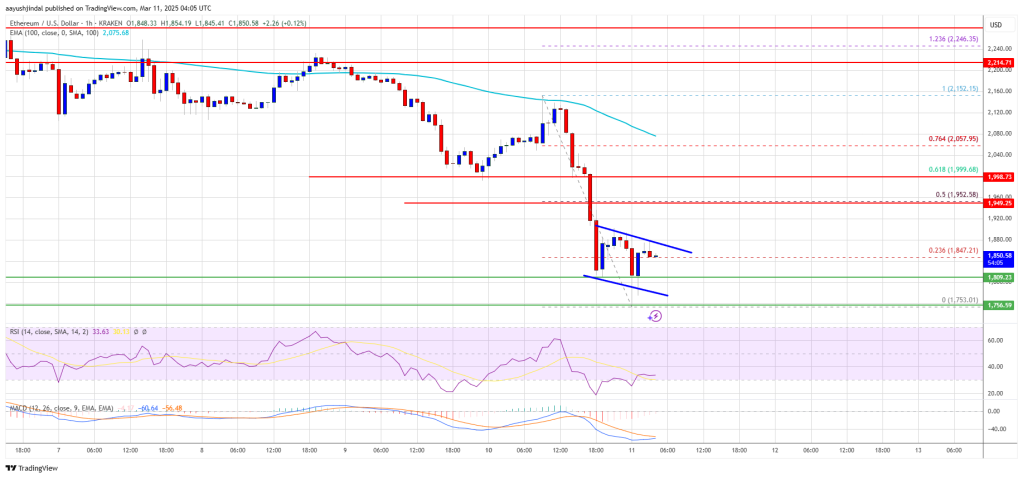
Ethereum price failed to clear the $2,120 resistance and trimmed gains. ETH is now consolidating and facing hurdles near the $2,000 resistance. Ethereum started a fresh decline below the key support at $2,000. The price is trading below $2,000 and the 100-hourly Simple Moving Average. There is a short-term declining channel forming with resistance at $1,880 on the hourly chart of ETH/USD (data feed via Kraken). The pair must clear the $1,880 and $1,950 resistance levels to start a decent increase. Ethereum Price Dips Further Ethereum price started a fresh decline from the $2,120 resistance, like Bitcoin. ETH declined below the $2,000 support to enter a bearish zone. The bears gained strength for a move below the $1,880 support. Finally, the bulls appeared near the $1,750 zone. A low was formed at $1,753 and the price is now attempting a recovery wave. There was a move above the $1,800 and $1,820 resistance levels. It cleared the 23.6% Fib retracement level of the downward move from the $2,152 swing high to the $1,753 low. Ethereum price is now trading below $2,000 and the 100-hourly Simple Moving Average. On the upside, the price seems to be facing hurdles near the $1,880 level. There is also a short-term declining channel forming with resistance at $1,880 on the hourly chart of ETH/USD. The next key resistance is near the $1,950 level. The 50% Fib retracement level of the downward move from the $2,152 swing high to the $1,753 low is also near the $1,950 level. The first major resistance is near the $2,000 level. A clear move above the $2,000 resistance might send the price toward the $2,120 resistance. An upside break above the $2,120 resistance might call for more gains in the coming sessions. In the stated case, Ether could rise toward the $2,250 resistance zone or even $2,350 in the near term. Another Drop In ETH? If Ethereum fails to clear the $1,880 resistance, it could start another decline. Initial support on the downside is near the $1,800 level. The first major support sits near the $1,750 zone. A clear move below the $1,750 support might push the price toward the $1,680 support. Any more losses might send the price toward the $1,620 support level in the near term. The next key support sits at $1,550. Technical Indicators Hourly MACD – The MACD for ETH/USD is losing momentum in the bearish zone. Hourly RSI – The RSI for ETH/USD is now below the 50 zone. Major Support Level – $1,750 Major Resistance Level – $1,880

Bitcoin Price Cracks $80K Support—Is a Deeper Correction Coming?

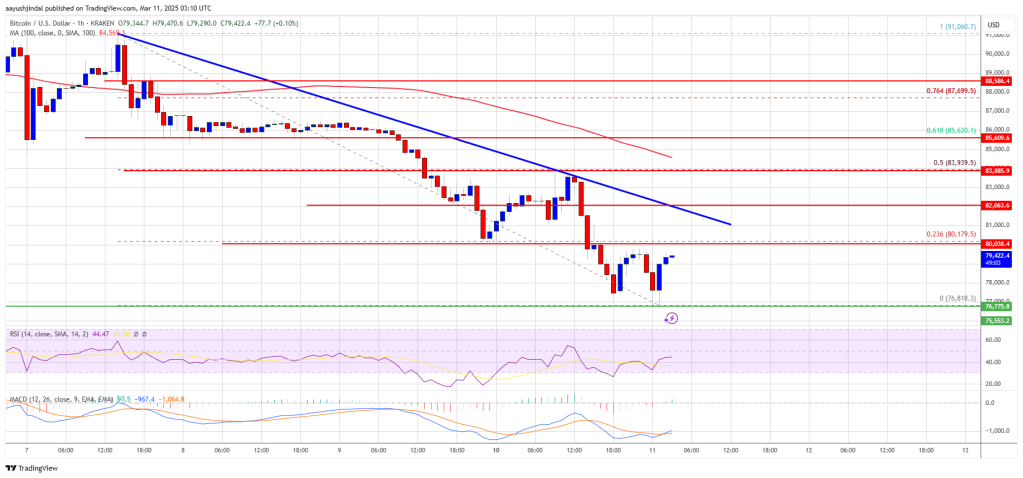
Bitcoin price started a fresh decline from the $90,000 zone. BTC is back below $82,500 and might continue to move down below $78,000. Bitcoin started a fresh decline below the $82,000 zone. The price is trading below $80,000 and the 100 hourly Simple moving average. There is a key bearish trend line forming with resistance at $82,200 on the hourly chart of the BTC/USD pair (data feed from Kraken). The pair could start another decline if it fails to clear the $82,000 resistance zone. Bitcoin Price Faces Hurdles Bitcoin price started a fresh decline below the $85,000 level. BTC traded below the $83,000 and $80,000 support levels. Finally, the price tested the $76,500 support zone. A low was formed at $76,818 and the price recently started a consolidation phase. There was a move above the $78,000 and $78,500 resistance levels. The bulls pushed the price toward the 23.6% Fib retracement level of the downward move from the $91,060 swing high to the $76,818 low. Bitcoin price is now trading below $80,000 and the 100 hourly Simple moving average. On the upside, immediate resistance is near the $80,200 level. The first key resistance is near the $82,000 level. There is also a key bearish trend line forming with resistance at $82,200 on the hourly chart of the BTC/USD pair. The next key resistance could be $84,000. It is near the 50% Fib retracement level of the downward move from the $91,060 swing high to the $76,818 low. A close above the $84,000 resistance might send the price further higher. In the stated case, the price could rise and test the $85,500 resistance level. Any more gains might send the price toward the $88,000 level or even $96,200. Another Drop In BTC? If Bitcoin fails to rise above the $82,000 resistance zone, it could start a fresh decline. Immediate support on the downside is near the $77,200 level. The first major support is near the $76,500 level. The next support is now near the $75,000 zone. Any more losses might send the price toward the $72,000 support in the near term. The main support sits at $70,000. Technical indicators: Hourly MACD – The MACD is now losing pace in the bearish zone. Hourly RSI (Relative Strength Index) – The RSI for BTC/USD is now below the 50 level. Major Support Levels – $76,500, followed by $75,000. Major Resistance Levels – $80,000 and $82,000.

Analyst Says Only Buy XRP If It Reaches This Level

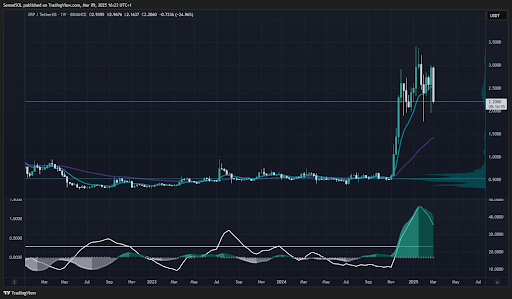
XRP has been caught in the broader market downturn over the past week, shedding 19% of its value amid a wave of bearish sentiment. This downturn comes despite the fact that many analysts remain optimistic about its long-term prospects. One particular technical analyst has now weighed in on when it would be wise to buy XRP, warning that its short-term outlook is shaky and its price may continue declining. Analyst Identifies The Ideal Buy Zone For XRP The past week has been challenging for XRP holders as the token has struggled to maintain key support levels. Its inability to hold these levels has pushed it closer to the $2 mark. However, the latest technical analysis suggests that this decline may not be over yet, and a further downside movement appears likely. Related Reading: Pundit Who Correctly Predicted XRP Price Crash To $2.5 Says Demand Zone Will Send It Soaring This XRP price decline has caused growing uncertainty among many retail investors, especially because XRP is increasingly becoming the choice of coin for retail investors in this cycle. Given XRP’s growing reputation as a retail favorite and its long-term bullish potential, this decline would be the best time for bullish investors to load up on more tokens. However, a crypto analyst recently warned that the current price is not the ideal entry point for those looking to capitalize on the coin’s bullish potential. Although XRP is one of the most promising cryptocurrencies from a technical perspective, the timing of purchases is also important. In a post on X, the analyst noted that XRP is the “retail coin,” often drawing attention from new investors who are convinced it will reach extreme price levels like $100. Despite this bullish momentum, he cautioned against buying at current prices, stating that the best time to enter would be if XRP dips to the $1.6 to $1.5 range. What this means is that the current trend suggests more downside movement in the short term, and it would be wiser to wait more before accumulating. Long-Term Bullish Case Despite Short-Term Weakness Even as XRP’s short-term outlook appears bearish, the analyst remains aligned with those expecting a major price surge in the future. Several technical analyses have painted an optimistic picture, with some projections placing the altcoin well beyond the double-digit threshold. One analyst, in particular, has even predicted a rally to $27 despite the ongoing market downturn. Related Reading: Crypto Pundit Reignites $100 XRP Price Target, What You Should Know The idea that XRP could eventually reach double and triple-digit valuations continues to attract investor interest, but this projection depends on market conditions and broader adoption trends. In the meantime, holders are struggling, without much success, to prevent a decline. At the time of writing, XRP is trading at $2.16, down by 7.04% in the past 24 hours. The onus now is on whether the price can hold above $2. Even if it breaks below this level, it only opens up the possibility of an accumulation range between $1.6 to $1.5. Featured image from Adobe Stock, chart from Tradingview.com

Pomp: Trump deliberately crashed markets to get interest rates down

The Trump administration may be intentionally creating uncertainty in the stock markets to corner Federal Reserve chair Jerome Powell into lowering interest rates, according to a market commentator. Doing so increases the likelihood that the US won’t need to refinance around $7 trillion in debt it owes over the next few months, Bitcoin commentator Anthony Pompliano said in a March 10 X post.US President Donald Trump and Secretary of the Treasury Scott Bessent are “taking matters into their own hands; they’re crashing asset prices in an attempt to force Jerome Powell to cut interest rates,” said Pompliano, who serves as the founder and CEO of Professional Capital Management and host of The Pomp Podcast. The President and his team are intentionally crashing the market.Is this a master plan or are we watching uncontrolled destruction?! pic.twitter.com/Tbc0M9Rjxu— Anthony Pompliano 🌪 (@APompliano) March 10, 2025In late January, Powell announced the Fed was not lowering interest rates from the current target range of 4.25% to 4.5% despite calls from Trump to do so.Pompliano said the recent market panic has been driven in part by Trump’s tariffs — and has been used to create a more favorable bond market while lowering the 10-year Treasury yield.He noted that the 10-year Treasury yield is already down from nearly 4.8% in January to 4.21% now — a sign that Trump’s purported strategy is “heading in the right direction.”Source: Thomas KralowWhether Pompliano’s theory is correct or not, the stock market has been tanking of late, and crypto has been hit even harder.Broad market index funds such as State Street’s Standard & Poor’s 500 index fund (SPY) fell 2.66% on March 10 alone, while the Nasdaq-100% fell 3.8%, Google Finance data shows.Both indexes are down 7.32% and 10.7% over the last month, while Bitcoin (BTC) is down 27.4% from its $108,786 all-time high, and over $1.2 trillion has been wiped from the cryptocurrency market cap since Dec. 17. If the stock market continues to tank, it will come down to a “who blinks first” contest between Trump and Powell, Pompliano said.While Trump hasn’t confirmed such a strategy, Pompliano pointed to a Fox News interview on March 9 where Trump said: “Nobody ever gets rich when the interest rates are high because people can’t borrow money.”Pompliano added that lowering interest rates would also benefit American consumers:“The big goal, get interest rates down, and that will lead to more economic activity, thanks to access to cheap capital. Give the people cheap capital and they’ll go and do things with it.”Related: Bitcoin dips to $80K in ‘ugly start,’ could retest key resistance: HayesCME FedWatch, a tool used to measure expectations for a Federal Reserve interest rate change, has tipped a 96% probability that the target rate will remain between 4.25% and 4.50% following the Federal Reserve’s next meeting on March 19. However, it’s near 50-50 odds for the target rate to be lowered in the Federal Reserve’s following meeting on May 7.The Federal Reserve typically avoids lowering interest rates when inflation is high, as one of its primary objectives is to maintain price stability.However, a Trump-inflicted recession, or “Trumpcession,” as some call it, could force America’s top bank to start cutting again.Magazine: Meet lawyer Max Burwick — ‘The ambulance chaser of crypto’

Pomp: Trump deliberately crashed markets to get interest rates down

The Trump administration may be intentionally creating uncertainty in the stock markets to corner Federal Reserve chair Jerome Powell into lowering interest rates, according to a market commentator. Doing so increases the likelihood that the US won’t need to refinance around $7 trillion in debt it owes over the next few months, Bitcoin commentator Anthony Pompliano said in a March 10 X post.US President Donald Trump and Secretary of the Treasury Scott Bessent are “taking matters into their own hands; they’re crashing asset prices in an attempt to force Jerome Powell to cut interest rates,” said Pompliano, who serves as the founder and CEO of Professional Capital Management and host of The Pomp Podcast. The President and his team are intentionally crashing the market.Is this a master plan or are we watching uncontrolled destruction?! pic.twitter.com/Tbc0M9Rjxu— Anthony Pompliano 🌪 (@APompliano) March 10, 2025In late January, Powell announced the Fed was not lowering interest rates from the current target range of 4.25% to 4.5% despite calls from Trump to do so.Pompliano said the recent market panic has been driven in part by Trump’s tariffs — and has been used to create a more favorable bond market while lowering the 10-year Treasury yield.He noted that the 10-year Treasury yield is already down from nearly 4.8% in January to 4.21% now — a sign that Trump’s purported strategy is “heading in the right direction.”Source: Thomas KralowWhether Pompliano’s theory is correct or not, the stock market has been tanking of late, and crypto has been hit even harder.Broad market index funds such as State Street’s Standard & Poor’s 500 index fund (SPY) fell 2.66% on March 10 alone, while the Nasdaq-100% fell 3.8%, Google Finance data shows.Both indexes are down 7.32% and 10.7% over the last month, while Bitcoin (BTC) is down 27.4% from its $108,786 all-time high, and over $1.2 trillion has been wiped from the cryptocurrency market cap since Dec. 17. If the stock market continues to tank, it will come down to a “who blinks first” contest between Trump and Powell, Pompliano said.While Trump hasn’t confirmed such a strategy, Pompliano pointed to a Fox News interview on March 9 where Trump said: “Nobody ever gets rich when the interest rates are high because people can’t borrow money.”Pompliano added that lowering interest rates would also benefit American consumers:“The big goal, get interest rates down, and that will lead to more economic activity, thanks to access to cheap capital. Give the people cheap capital and they’ll go and do things with it.”Related: Bitcoin dips to $80K in ‘ugly start,’ could retest key resistance: HayesCME FedWatch, a tool used to measure expectations for a Federal Reserve interest rate change, has tipped a 96% probability that the target rate will remain between 4.25% and 4.50% following the Federal Reserve’s next meeting on March 19. However, it’s near 50-50 odds for the target rate to be lowered in the Federal Reserve’s following meeting on May 7.The Federal Reserve typically avoids lowering interest rates when inflation is high, as one of its primary objectives is to maintain price stability.However, a Trump-inflicted recession, or “Trumpcession,” as some call it, could force America’s top bank to start cutting again.Magazine: Meet lawyer Max Burwick — ‘The ambulance chaser of crypto’

Pomp: Trump deliberately crashed markets to get interest rates down

The Trump administration may be intentionally creating uncertainty in the stock markets to corner Federal Reserve chair Jerome Powell into lowering interest rates, according to a market commentator. Doing so increases the likelihood that the US won’t need to refinance around $7 trillion in debt it owes over the next few months, Bitcoin commentator Anthony Pompliano said in a March 10 X post.US President Donald Trump and Secretary of the Treasury Scott Bessent are “taking matters into their own hands; they’re crashing asset prices in an attempt to force Jerome Powell to cut interest rates,” said Pompliano, who serves as the founder and CEO of Professional Capital Management and host of The Pomp Podcast. The President and his team are intentionally crashing the market.Is this a master plan or are we watching uncontrolled destruction?! pic.twitter.com/Tbc0M9Rjxu— Anthony Pompliano 🌪 (@APompliano) March 10, 2025In late January, Powell announced the Fed was not lowering interest rates from the current target range of 4.25% to 4.5% despite calls from Trump to do so.Pompliano said the recent market panic has been driven in part by Trump’s tariffs — and has been used to create a more favorable bond market while lowering the 10-year Treasury yield.He noted that the 10-year Treasury yield is already down from nearly 4.8% in January to 4.21% now — a sign that Trump’s purported strategy is “heading in the right direction.”Source: Thomas KralowWhether Pompliano’s theory is correct or not, the stock market has been tanking of late, and crypto has been hit even harder.Broad market index funds such as State Street’s Standard & Poor’s 500 index fund (SPY) fell 2.66% on March 10 alone, while the Nasdaq-100% fell 3.8%, Google Finance data shows.Both indexes are down 7.32% and 10.7% over the last month, while Bitcoin (BTC) is down 27.4% from its $108,786 all-time high, and over $1.2 trillion has been wiped from the cryptocurrency market cap since Dec. 17. If the stock market continues to tank, it will come down to a “who blinks first” contest between Trump and Powell, Pompliano said.While Trump hasn’t confirmed such a strategy, Pompliano pointed to a Fox News interview on March 9 where Trump said: “Nobody ever gets rich when the interest rates are high because people can’t borrow money.”Pompliano added that lowering interest rates would also benefit American consumers:“The big goal, get interest rates down, and that will lead to more economic activity, thanks to access to cheap capital. Give the people cheap capital and they’ll go and do things with it.”Related: Bitcoin dips to $80K in ‘ugly start,’ could retest key resistance: HayesCME FedWatch, a tool used to measure expectations for a Federal Reserve interest rate change, has tipped a 96% probability that the target rate will remain between 4.25% and 4.50% following the Federal Reserve’s next meeting on March 19. However, it’s near 50-50 odds for the target rate to be lowered in the Federal Reserve’s following meeting on May 7.The Federal Reserve typically avoids lowering interest rates when inflation is high, as one of its primary objectives is to maintain price stability.However, a Trump-inflicted recession, or “Trumpcession,” as some call it, could force America’s top bank to start cutting again.Magazine: Meet lawyer Max Burwick — ‘The ambulance chaser of crypto’