
Category: Cryptocurrency News

Cryptocurrency News and Public Mining Pools

US stablecoin bill gets update ahead of Senate banking group vote

US Senate Banking Committee is set to vote on a Republican-led stablecoin framework bill on March 13, after it was updated following consultation with committee Democrats.GOP Senator Bill Hagerty, one of the bill’s co-sponsors, said on March 10 that he introduced an update of the Guiding and Establishing National Innovation for US Stablecoins (GENIUS) Act, which would go to a Banking Committee vote on March 13.He added that the updated bill saw bipartisan consultation. The bill is co-sponsored by Republican Senators Cynthia Lummis and Tim Scott, who is also chair of the Banking Committee chair, along with Democrats Kirsten Gillibrand and Angela Alsobrooks.“The updated version of the GENIUS Act makes significant improvements to a number of important provisions, including consumer protections, authorized stablecoin issuers, risk mitigation, state pathways, insolvency, transparency, and more,” Gillibrand said in a statement.Hagerty first introduced the bill in early February. It aims to bring issuers of US dollar stablecoins with market caps over $10 billion — currently only Tether (USDT) and Circle’s USDC (USDC) — under Federal Reserve regulations. Those under $10 billion could opt into state-level regulation.Web3 learning app EasyA co-founder Dom Kwok said on X that the latest version of the GENIUS Act, shared by FOX Business reporter Eleanor Terrett, gives “US-issued stablecoins a competitive advantage.”He added that the bill now holds foreign stablecoin issuers to “extra high standards” in areas such as reserve and liquidity requirements, money laundering checks and sanctions checks.Source: Dom Kwok“Most foreign issuers will find these standards hard to meet,” which gives Circle’s USDC and Ripple Labs’ Ripple USD (RLUSD) “an upper hand,” he said.Related: Crypto needs policy change more than Bitcoin reserve — ExecsCrypto lawyer and Hogan & Hogan partner Jeremy Hogan came to the same conclusion in a separate X post, saying the bill’s requirements, particularly around reserves and Anti-Money Laundering checks, “all fall neatly for RLSUD and USDC.”The GENIUS Act still has a way to go before becoming law. The Senate Banking Committee will have to vote to pass the bill and it will then be put to a full Senate floor vote where it could be debated.If it passes the Senate, it will head to the House. If the House doesn’t change the bill, then it will be sent to President Donald Trump to sign into law or veto.Magazine: How crypto laws are changing across the world in 2025 
US stablecoin bill gets update ahead of Senate banking group vote

US Senate Banking Committee is set to vote on a Republican-led stablecoin framework bill on March 13, after it was updated following consultation with committee Democrats.GOP Senator Bill Hagerty, one of the bill’s co-sponsors, said on March 10 that he introduced an update of the Guiding and Establishing National Innovation for US Stablecoins (GENIUS) Act, which would go to a Banking Committee vote on March 13.He added that the updated bill saw bipartisan consultation. The bill is co-sponsored by Republican Senators Cynthia Lummis and Tim Scott, who is also chair of the Banking Committee chair, along with Democrats Kirsten Gillibrand and Angela Alsobrooks.“The updated version of the GENIUS Act makes significant improvements to a number of important provisions, including consumer protections, authorized stablecoin issuers, risk mitigation, state pathways, insolvency, transparency, and more,” Gillibrand said in a statement.Hagerty first introduced the bill in early February. It aims to bring issuers of US dollar stablecoins with market caps over $10 billion — currently only Tether (USDT) and Circle’s USDC (USDC) — under Federal Reserve regulations. Those under $10 billion could opt into state-level regulation.Web3 learning app EasyA co-founder Dom Kwok said on X that the latest version of the GENIUS Act, shared by FOX Business reporter Eleanor Terrett, gives “US-issued stablecoins a competitive advantage.”He added that the bill now holds foreign stablecoin issuers to “extra high standards” in areas such as reserve and liquidity requirements, money laundering checks and sanctions checks.Source: Dom Kwok“Most foreign issuers will find these standards hard to meet,” which gives Circle’s USDC and Ripple Labs’ Ripple USD (RLUSD) “an upper hand,” he said.Related: Crypto needs policy change more than Bitcoin reserve — ExecsCrypto lawyer and Hogan & Hogan partner Jeremy Hogan came to the same conclusion in a separate X post, saying the bill’s requirements, particularly around reserves and Anti-Money Laundering checks, “all fall neatly for RLSUD and USDC.”The GENIUS Act still has a way to go before becoming law. The Senate Banking Committee will have to vote to pass the bill and it will then be put to a full Senate floor vote where it could be debated.If it passes the Senate, it will head to the House. If the House doesn’t change the bill, then it will be sent to President Donald Trump to sign into law or veto.Magazine: How crypto laws are changing across the world in 2025 
US stablecoin bill gets update ahead of Senate banking group vote

US Senate Banking Committee is set to vote on a Republican-led stablecoin framework bill on March 13, after it was updated following consultation with committee Democrats.GOP Senator Bill Hagerty, one of the bill’s co-sponsors, said on March 10 that he introduced an update of the Guiding and Establishing National Innovation for US Stablecoins (GENIUS) Act, which would go to a Banking Committee vote on March 13.He added that the updated bill saw bipartisan consultation. The bill is co-sponsored by Republican Senators Cynthia Lummis and Tim Scott, who is also chair of the Banking Committee chair, along with Democrats Kirsten Gillibrand and Angela Alsobrooks.“The updated version of the GENIUS Act makes significant improvements to a number of important provisions, including consumer protections, authorized stablecoin issuers, risk mitigation, state pathways, insolvency, transparency, and more,” Gillibrand said in a statement.Hagerty first introduced the bill in early February. It aims to bring issuers of US dollar stablecoins with market caps over $10 billion — currently only Tether (USDT) and Circle’s USDC (USDC) — under Federal Reserve regulations. Those under $10 billion could opt into state-level regulation.Web3 learning app EasyA co-founder Dom Kwok said on X that the latest version of the GENIUS Act, shared by FOX Business reporter Eleanor Terrett, gives “US-issued stablecoins a competitive advantage.”He added that the bill now holds foreign stablecoin issuers to “extra high standards” in areas such as reserve and liquidity requirements, money laundering checks and sanctions checks.Source: Dom Kwok“Most foreign issuers will find these standards hard to meet,” which gives Circle’s USDC and Ripple Labs’ Ripple USD (RLUSD) “an upper hand,” he said.Related: Crypto needs policy change more than Bitcoin reserve — ExecsCrypto lawyer and Hogan & Hogan partner Jeremy Hogan came to the same conclusion in a separate X post, saying the bill’s requirements, particularly around reserves and Anti-Money Laundering checks, “all fall neatly for RLSUD and USDC.”The GENIUS Act still has a way to go before becoming law. The Senate Banking Committee will have to vote to pass the bill and it will then be put to a full Senate floor vote where it could be debated.If it passes the Senate, it will head to the House. If the House doesn’t change the bill, then it will be sent to President Donald Trump to sign into law or veto.Magazine: How crypto laws are changing across the world in 2025 

US stablecoin bill gets update ahead of Senate banking group vote

US Senate Banking Committee is set to vote on a Republican-led stablecoin framework bill on March 13, after it was updated following consultation with committee Democrats.GOP Senator Bill Hagerty, one of the bill’s co-sponsors, said on March 10 that he introduced an update of the Guiding and Establishing National Innovation for US Stablecoins (GENIUS) Act, which would go to a Banking Committee vote on March 13.He added that the updated bill saw bipartisan consultation. The bill is co-sponsored by Republican Senators Cynthia Lummis and Tim Scott, who is also chair of the Banking Committee chair, along with Democrats Kirsten Gillibrand and Angela Alsobrooks.“The updated version of the GENIUS Act makes significant improvements to a number of important provisions, including consumer protections, authorized stablecoin issuers, risk mitigation, state pathways, insolvency, transparency, and more,” Gillibrand said in a statement.Hagerty first introduced the bill in early February. It aims to bring issuers of US dollar stablecoins with market caps over $10 billion — currently only Tether (USDT) and Circle’s USDC (USDC) — under Federal Reserve regulations. Those under $10 billion could opt into state-level regulation.Web3 learning app EasyA co-founder Dom Kwok said on X that the latest version of the GENIUS Act, shared by FOX Business reporter Eleanor Terrett, gives “US-issued stablecoins a competitive advantage.”He added that the bill now holds foreign stablecoin issuers to “extra high standards” in areas such as reserve and liquidity requirements, money laundering checks and sanctions checks.Source: Dom Kwok“Most foreign issuers will find these standards hard to meet,” which gives Circle’s USDC and Ripple Labs’ Ripple USD (RLUSD) “an upper hand,” he said.Related: Crypto needs policy change more than Bitcoin reserve — ExecsCrypto lawyer and Hogan & Hogan partner Jeremy Hogan came to the same conclusion in a separate X post, saying the bill’s requirements, particularly around reserves and Anti-Money Laundering checks, “all fall neatly for RLSUD and USDC.”The GENIUS Act still has a way to go before becoming law. The Senate Banking Committee will have to vote to pass the bill and it will then be put to a full Senate floor vote where it could be debated.If it passes the Senate, it will head to the House. If the House doesn’t change the bill, then it will be sent to President Donald Trump to sign into law or veto.Magazine: How crypto laws are changing across the world in 2025 

US stablecoin bill gets update ahead of Senate banking group vote

US Senate Banking Committee is set to vote on a Republican-led stablecoin framework bill on March 13, after it was updated following consultation with committee Democrats.GOP Senator Bill Hagerty, one of the bill’s co-sponsors, said on March 10 that he introduced an update of the Guiding and Establishing National Innovation for US Stablecoins (GENIUS) Act, which would go to a Banking Committee vote on March 13.He added that the updated bill saw bipartisan consultation. The bill is co-sponsored by Republican Senators Cynthia Lummis and Tim Scott, who is also chair of the Banking Committee chair, along with Democrats Kirsten Gillibrand and Angela Alsobrooks.“The updated version of the GENIUS Act makes significant improvements to a number of important provisions, including consumer protections, authorized stablecoin issuers, risk mitigation, state pathways, insolvency, transparency, and more,” Gillibrand said in a statement.Hagerty first introduced the bill in early February. It aims to bring issuers of US dollar stablecoins with market caps over $10 billion — currently only Tether (USDT) and Circle’s USDC (USDC) — under Federal Reserve regulations. Those under $10 billion could opt into state-level regulation.Web3 learning app EasyA co-founder Dom Kwok said on X that the latest version of the GENIUS Act, shared by FOX Business reporter Eleanor Terrett, gives “US-issued stablecoins a competitive advantage.”He added that the bill now holds foreign stablecoin issuers to “extra high standards” in areas such as reserve and liquidity requirements, money laundering checks and sanctions checks.Source: Dom Kwok“Most foreign issuers will find these standards hard to meet,” which gives Circle’s USDC and Ripple Labs’ Ripple USD (RLUSD) “an upper hand,” he said.Related: Crypto needs policy change more than Bitcoin reserve — ExecsCrypto lawyer and Hogan & Hogan partner Jeremy Hogan came to the same conclusion in a separate X post, saying the bill’s requirements, particularly around reserves and Anti-Money Laundering checks, “all fall neatly for RLSUD and USDC.”The GENIUS Act still has a way to go before becoming law. The Senate Banking Committee will have to vote to pass the bill and it will then be put to a full Senate floor vote where it could be debated.If it passes the Senate, it will head to the House. If the House doesn’t change the bill, then it will be sent to President Donald Trump to sign into law or veto.Magazine: How crypto laws are changing across the world in 2025 

Dogecoin (DOGE) Under Pressure—Continues Sliding Into Bear Territory

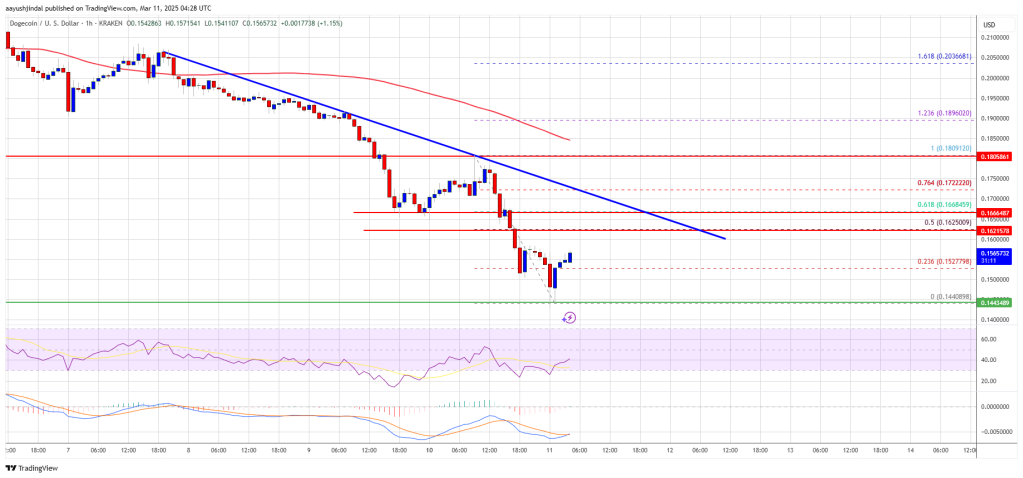
Dogecoin started a fresh decline below the $0.1850 zone against the US Dollar. DOGE tested $0.1450 and is now consolidating below the $0.1650 resistance. DOGE price started a fresh decline below the $0.2000 and $0.1850 levels. The price is trading below the $0.1750 level and the 100-hourly simple moving average. There is a connecting bearish trend line forming with resistance at $0.1680 on the hourly chart of the DOGE/USD pair (data source from Kraken). The price could start a recovery if it clears the $0.1620 and $0.1680 resistance levels. Dogecoin Price Dives Further Dogecoin price started a fresh decline below the $0.2000 zone, like Bitcoin and Ethereum. DOGE dipped below the $0.1850 and $0.1680 support levels. It even spiked below $0.1620. A low was formed at $0.1440 and the price is now consolidating losses. There was a move above the $0.1500 level. The bulls pushed the price above the 23.6% Fib retracement level of the downward move from the $0.1809 swing high to the $0.1440 low. Dogecoin price is now trading below the $0.1850 level and the 100-hourly simple moving average. Immediate resistance on the upside is near the $0.1620 level or the 50% Fib retracement level of the downward move from the $0.1809 swing high to the $0.1440 low. The first major resistance for the bulls could be near the $0.1680 level. There is also a connecting bearish trend line forming with resistance at $0.1680 on the hourly chart of the DOGE/USD pair. The next major resistance is near the $0.1720 level. A close above the $0.1720 resistance might send the price toward the $0.1850 resistance. Any more gains might send the price toward the $0.2000 level. The next major stop for the bulls might be $0.2050. More Losses In DOGE? If DOGE’s price fails to climb above the $0.1680 level, it could start another decline. Initial support on the downside is near the $0.150 level. The next major support is near the $0.1450 level. The main support sits at $0.1420. If there is a downside break below the $0.1420 support, the price could decline further. In the stated case, the price might decline toward the $0.1350 level or even $0.1250 in the near term. Technical Indicators Hourly MACD – The MACD for DOGE/USD is now losing momentum in the bearish zone. Hourly RSI (Relative Strength Index) – The RSI for DOGE/USD is now below the 50 level. Major Support Levels – $0.1500 and $0.1450. Major Resistance Levels – $0.1680 and $0.1880.

Bitcoin Slips Below $80,000—Here’s What Could Happen Next

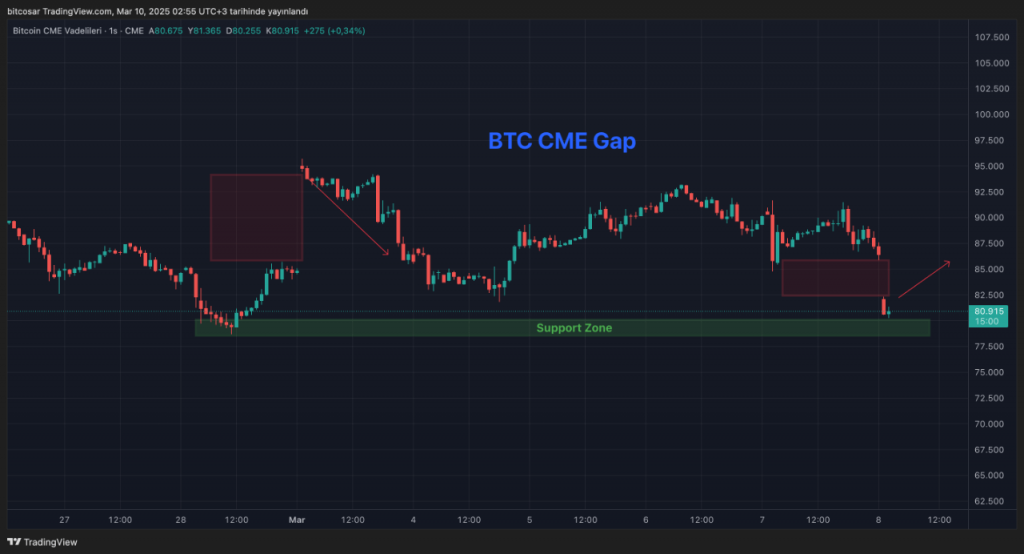
Bitcoin’s price has continued its downward trend, struggling to regain momentum after reaching its all-time high of $109,000 in January. Over the past week, Bitcoin has declined by 14.6%, with its price dropping an additional 4.4% in the last 24 hours. As of today, Bitcoin is trading at $79,766, pushing it nearly 27% below its ATH. Amid this price performance, CryptoQuant analyst ibrahimcosar has closely examined Bitcoin’s price movements, focusing on the CME gap phenomenon, which has historically played a role in Bitcoin’s short-term fluctuations. Related Reading: Crypto Pundit Dumps Bitcoin Holdings Sub-$100,000, Lists Reasons Why It’s Time To Short What To Expect From Bitcoin Based On CME Gap In his latest analysis, Ibrahim highlighted how BTC opened at $82,110 on the CME, creating a gap up to the $86K level. According to him, this price gap could provide clues about Bitcoin’s next move, potentially leading to a short-term attempt at reclaiming $86K–$90K in the coming days. The CME gap refers to the difference between BTC’s closing price on the Chicago Mercantile Exchange (CME) before the weekend and its opening price after the weekend. These gaps often get filled as BTC’s price moves back to the levels where the trading pause occurred. Ibrahim notes that Bitcoin previously formed a $10,000 gap on February 28, which was quickly filled within 19 hours. Now, with BTC currently trading around $79K–$80K, the analyst suggests that another gap has formed above the current price range, indicating that Bitcoin may attempt to fill the $86K–$90K region within the next one to two days. However, he cautions that this does not necessarily signal a full reversal in BTC’s downtrend. Instead, he maintains that Bitcoin’s broader trend remains uncertain, and its price action through March and early April will be key in determining whether a stronger recovery is on the horizon. Key Support Levels and Market Sentiment Another market analyst, ShayanBTC, has pointed to $83,000 as a critical support level, based on Bitcoin’s interaction with the Realized Price of 3-6 Month UTXOs. This metric tracks the average acquisition price of mid-term holders and has historically acted as a significant support or resistance zone. Shayan disclosed that BTC recently tested this level, and holding above it could signal strong investor confidence, potentially reinforcing bullish sentiment. However, Bitcoin’s decline below $80,000 suggests that this $83,000 support level has already been breached. If Bitcoin fails to regain ground above this threshold, market sentiment could shift towards fear, leading to increased selling pressure from mid-term holders. In this scenario, BTC could enter a distribution phase, where short to mid-term investors sell their holdings, further driving the price downward. Ibrahim has identified the $78,000–$80,000 region as the next key support zone, which may determine BTC’s near-term trajectory. Featured image created with DALL-E, Chart from TradingView

Regulatory Hurdles Fail to Deter Binance’s Popularity in Nigeria

Binance has been identified as the top cryptocurrency exchange for Nigerians due to its strong peer-to-peer (P2P) marketplace, which facilitates trading using local payment methods. Binance Stands out Despite Ongoing Dispute With Nigerian Officials Binance has been ranked the number one cryptocurrency exchange for Nigerians primarily because of its robust peer-to-peer (P2P) marketplace, which allows […]

Trump crypto push could hurt Europe’s financial stability: Top EU official

Finance officials in the European Union are concerned US President Donald Trump’s embrace of digital assets could affect Europe’s monetary sovereignty and financial stability.“The US administration is favorable toward cryptocurrencies and especially dollar-denominated stablecoins, which may raise certain concerns in Europe,” European Stability Mechanism (ESM) managing director Pierre Gramegna said at a Eurogroup press conference on March 10. Gramegna cautioned that the US crypto pivot “could eventually reignite foreign and US tech giants’ plans to launch mass payment solutions based on dollar-denominated stablecoin,” adding, “And if this were to be successful, it could affect the euro area’s monetary sovereignty and financial stability.”  The ESM “supports the ECB’s urgency in making the digital euro a reality to safeguard Europe’s strategic autonomy — this digital euro is today more necessary than ever,” he added.The ESM is an intergovernmental organization established by member states of the euro area, helping countries overcome financial crises and maintain long-term financial stability and prosperity.Pierre Gramegna speaking on US crypto threat. Source: YouTube“Policy developments in other jurisdictions can have important consequences for us here in Europe,” concurred Irish finance minister Paschal Donohoe. “These discussions are fundamentally linked to our own autonomy and to the resilience of our currency,” he added, stating that a European central bank digital currency (CBDC) was now critical to staying ahead of the curve.In February, the European Central Bank said it was expanding the development of its CBDC payment system to settle transactions between institutions. The ECB has been exploring CBDCs since 2020, including a consumer-facing retail digital euro and wholesale cross-border settlement between central banks.Meanwhile, Trump has spoken out against a Federal Reserve CBDC, signing an executive order in January to establish a crypto working group while prohibiting the “establishment, issuance, circulation, and use” of a US CBDC. Related: Crypto academics slam controversial ECB paper blasting BitcoinThe ECB has also rejected the idea of adding Bitcoin (BTC) to its monetary reserves or allowing other European central banks to do so. In late January, ECB President Christine Lagarde said that the reserves of central banks have to be “liquid, secure and safe,” implying that they would not include crypto assets. She added that she was “confident” that Bitcoin would not enter the reserves of banks under the European Council. Magazine: Bitcoin’s odds of June highs, SOL’s $485M outflows, and more: Hodler’s Digest

Trump crypto push could hurt Europe’s financial stability: Top EU official

Finance officials in the European Union are concerned US President Donald Trump’s embrace of digital assets could affect Europe’s monetary sovereignty and financial stability.“The US administration is favorable toward cryptocurrencies and especially dollar-denominated stablecoins, which may raise certain concerns in Europe,” European Stability Mechanism (ESM) managing director Pierre Gramegna said at a Eurogroup press conference on March 10. Gramegna cautioned that the US crypto pivot “could eventually reignite foreign and US tech giants’ plans to launch mass payment solutions based on dollar-denominated stablecoin,” adding, “And if this were to be successful, it could affect the euro area’s monetary sovereignty and financial stability.”  The ESM “supports the ECB’s urgency in making the digital euro a reality to safeguard Europe’s strategic autonomy — this digital euro is today more necessary than ever,” he added.The ESM is an intergovernmental organization established by member states of the euro area, helping countries overcome financial crises and maintain long-term financial stability and prosperity.Pierre Gramegna speaking on US crypto threat. Source: YouTube“Policy developments in other jurisdictions can have important consequences for us here in Europe,” concurred Irish finance minister Paschal Donohoe. “These discussions are fundamentally linked to our own autonomy and to the resilience of our currency,” he added, stating that a European central bank digital currency (CBDC) was now critical to staying ahead of the curve.In February, the European Central Bank said it was expanding the development of its CBDC payment system to settle transactions between institutions. The ECB has been exploring CBDCs since 2020, including a consumer-facing retail digital euro and wholesale cross-border settlement between central banks.Meanwhile, Trump has spoken out against a Federal Reserve CBDC, signing an executive order in January to establish a crypto working group while prohibiting the “establishment, issuance, circulation, and use” of a US CBDC. Related: Crypto academics slam controversial ECB paper blasting BitcoinThe ECB has also rejected the idea of adding Bitcoin (BTC) to its monetary reserves or allowing other European central banks to do so. In late January, ECB President Christine Lagarde said that the reserves of central banks have to be “liquid, secure and safe,” implying that they would not include crypto assets. She added that she was “confident” that Bitcoin would not enter the reserves of banks under the European Council. Magazine: Bitcoin’s odds of June highs, SOL’s $485M outflows, and more: Hodler’s Digest