Category: Cryptocurrency News

Cryptocurrency News and Public Mining Pools

Trump’s Strategic Bitcoin Reserve and Digital Asset Stockpile, explained

A quick history of Trump’s statements and policies on crypto Donald Trump’s stance on cryptocurrency has shifted significantly over time. From 2019 to 2021, Trump expressed skepticism toward Bitcoin (BTC), calling it volatile and a threat to the US dollar, but by 2024, he reversed his stance, pledging support for crypto, proposing a US Strategic Bitcoin Reserve and criticizing the Biden administration’s anti-crypto policies.Early skepticism (2019–2021)July 2019: While in office, Trump tweeted that he was “not a fan” of Bitcoin, calling it “not money” and criticizing its volatility. He also opposed Facebook’s Libra (Diem) project, arguing that tech companies shouldn’t issue currency without a banking charter.June 2021: After leaving office, Trump labeled Bitcoin a “scam” and a threat to the US dollar, advocating for strict regulation to prevent it from undermining the US financial system.Crypto policy during his presidency (2017–2020)Trump’s administration generally took a cautious stance on crypto:Treasury Secretary Steven Mnuchin warned of Bitcoin’s risks and dismissed its long-term viability.The Treasury Department proposed stricter tracking rules for digital wallets, which faced industry backlash.Some Trump appointees supported crypto-friendly banking policies, but these were exceptions to an overall skeptical approach.Pro-crypto pivot in 2024Ahead of the 2024 election, Trump reversed course, pledging to end the Biden administration’s “anti-crypto” stance. He:Declared himself “very positive and open-minded” on Bitcoin.Promised to fire top crypto-skeptic regulators if reelected.Proposed a US Strategic Bitcoin Reserve, vowing to hold on to seized Bitcoin instead of auctioning it off.This dramatic shift set the foundation for Trump’s strategic Bitcoin reserve.  The Strategic Bitcoin Reserve: What does it mean? One of Trump’s headline proposals is creating a Strategic Bitcoin Reserve for the US, treating Bitcoin as a national reserve asset akin to digital gold. The plan centers on stockpiling Bitcoin seized in criminal cases rather than purchasing it with taxpayer funds.Key componentsBitcoin as a reserve asset: The US government would officially recognize Bitcoin as a strategic holding, similar to gold in Fort Knox, leveraging its fixed supply and decentralized nature.Seized crypto, not taxpayer purchases: Instead of selling confiscated Bitcoin at auction (as has been past practice), the government would retain it in a central reserve account. Trump’s executive order explicitly states that any Bitcoin deposited “shall not be sold.”No immediate buying spree: The plan does not include direct federal purchases of BTC but allows for “budget-neutral” methods to expand reserves, such as using proceeds from other seized assets.Does the US already have a Bitcoin stockpile? Yes, indirectly. Over the past decade, agencies have seized large amounts of BTC but historically auctioned it off rather than holding it. Trump’s policy would change that, aiming to preserve Bitcoin as a national asset.Supporters believe this could strengthen US finances and ensure the nation isn’t left behind in a Bitcoin-driven global economy. However, critics warn of Bitcoin’s volatility and the risks of integrating a decentralized asset into government reserves. Is the Bitcoin strategic reserve the same as the digital asset stockpile? No, a digital asset stockpile is a separate reserve that would hold other forfeited cryptocurrencies.The Strategic Bitcoin Reserve focuses solely on holding Bitcoin as a reserve asset, while the Digital Asset Stockpile includes other forfeited digital assets such as Ether (ETH) or USDC (USDC), though these assets might be strategically managed or sold over time. Bitcoin, however, would be held indefinitely in the reserve.Notably, Trump’s executive order does not explicitly mention what specific crypto assets will be included in the US Digital Asset Stockpile. Here are the commonalities and differences between the Strategic Bitcoin Reserve and the US Digital Asset Stockpile: Historical context: US government and Bitcoin Trump’s Bitcoin reserve plan builds on a history of US government interactions with cryptocurrency, primarily through law enforcement and asset seizures.Seizures and auctions (Silk Road era)The government’s relationship with Bitcoin began in 2013–2014 with the Silk Road takedown, where federal agents seized 144,000 BTC — one of the largest Bitcoin hauls ever. Rather than holding the coins, the US Marshals Service auctioned them off, setting a precedent for liquidating seized crypto. Did you know? In 2014, venture capitalist Tim Draper bought 30,000 BTC for $18 million, a fraction of its later value.Accumulating and selling crypto holdingsSince then, US agencies have continued seizing and auctioning Bitcoin from various cases, selling nearly 200,000 BTC between 2014 and early 2023, netting around $366 million. However, with Bitcoin’s price surge, those sold coins would now be worth over $18 billion — raising questions about whether the government should have held onto them. Crypto advocates argue this history justifies a hodl policy rather than continued liquidation.Past administration policiesObama administration: Focused on regulating exchanges and curbing illicit use.Trump’s first term: Emphasized enforcement, sanctioning crypto accounts linked to adversaries and targeting tax evaders.Biden administration: Prioritized investor protection and regulatory enforcement, pursuing lawsuits against major exchanges in 2023 and continuing liquidation of seized Bitcoin rather than holding it.The idea of a national Bitcoin reserve was largely absent from previous administrations — until Trump’s 2024 proposal.Global contextOther governments, including China and Germany, have seized Bitcoin, but most — like the US — chose to auction it rather than stockpile it. No major economy has yet integrated Bitcoin into its sovereign reserves. The closest example is El Salvador, which made Bitcoin legal tender in 2021 and began accumulating it. If fully implemented, Trump’s Bitcoin reserve strategy would make the US the first major nation to officially hold Bitcoin as a strategic asset, a significant shift in global crypto policy.Did you know? ​In 2024, Bhutan’s sovereign investment arm quietly amassed $750 million in Bitcoin holdings through hydroelectric-powered mining, amounting to 28% of the country’s gross domestic product. Potential impact of a Strategic Bitcoin Reserve If the US establishes a Strategic Bitcoin Reserve, the implications could be significant for markets, regulation and financial strategy.Market dynamicsA no-sell policy would remove key selling pressure, as seized Bitcoin would no longer be auctioned off, effectively reducing circulating supply. Some analysts see this as bullish for Bitcoin’s price. Anticipation of Trump’s pro-crypto stance already fueled market optimism in late 2024. However, political shifts could bring uncertainty — future administrations might reverse the policy and sell, making government-held Bitcoin a new market-moving factor.Legitimacy and mainstreamingIf the US holds Bitcoin as a strategic asset, it would mark the strongest government endorsement of crypto to date. This could encourage institutional investors and pressure other nations to consider similar policies. If multiple governments start stockpiling Bitcoin, it could integrate crypto more deeply into global finance, potentially affecting reserve diversification and even international sanctions.Regulatory shiftA national Bitcoin reserve aligns with a broader pro-crypto shift in US regulation. Trump has already signaled a friendlier stance, calling for clearer rules and protecting crypto firms’ banking access. This could reverse past regulatory hostility, making the US a more attractive hub for blockchain businesses.With the government holding Bitcoin, it may also incentivize policies that promote crypto growth, though balancing innovation and consumer protection remains a challenge.Did you know? ​In 2025, President Trump appointed David Sacks as the White House AI and crypto czar to establish a legal framework for the cryptocurrency industry.Financial strategy and the dollarTrump insists Bitcoin won’t replace the US dollar, but holding it as a reserve asset could complement rather than compete with the dollar — similar to gold. If Bitcoin appreciates, it could strengthen US financial standing, but if it gains too much influence in global reserves, it might challenge fiat dominance over time.While speculative for now, a national Bitcoin reserve could reshape the role of digital assets in global finance. Challenges and controversies Trump’s Bitcoin reserve plan has sparked both enthusiasm and criticism. Key concerns include volatility, political optics and legal hurdles.Volatility and riskBitcoin’s price swings make it a risky reserve asset. Unlike gold or US Treasurys, Bitcoin can drop 10% in a day, raising concerns about exposing taxpayer-linked reserves to major losses. Critics compare it to gambling with public funds, while supporters argue that not holding Bitcoin poses a bigger risk if it continues to appreciate.Political “flip-flop”Trump once called Bitcoin a threat to the dollar, but now champions it. Opponents see this as opportunism, driven by campaign donations from crypto investors rather than a genuine policy shift. Supporters argue it reflects Republican modernization, appealing to a younger, crypto-friendly voter base.Favoring Bitcoin over other cryptocurrenciesBy stockpiling Bitcoin, the government may be seen as picking winners and losers in the crypto market. This could marginalize smaller tokens and raise concerns over market intervention. Some fear Trump’s crypto agenda could slow down broader regulation by making the issue partisan.Legal and logistical hurdlesTransferring seized Bitcoin into a government reserve isn’t simple. Current laws mandate auctions, meaning Congress may need to intervene. Additionally, securing billions in crypto requires top-tier cybersecurity, as hacks or key losses could be disastrous. Lawmakers are also pushing for transparency on how much Bitcoin the government actually holds.Economic strategy uncertaintyHow does Bitcoin fit into US monetary policy? The Federal Reserve does not currently treat crypto as part of its system. If the Treasury holds Bitcoin, would it influence monetary decisions or simply remain an investment? Trump’s policy also bans a US central bank digital currency to prevent competition with private crypto, raising questions about the coherence of US financial strategy.The Bitcoin reserve experiment could reshape US crypto policy — or create new complexities that challenge its long-term viability.


Trump’s Strategic Bitcoin Reserve and Digital Asset Stockpile, explained

A quick history of Trump’s statements and policies on crypto Donald Trump’s stance on cryptocurrency has shifted significantly over time. From 2019 to 2021, Trump expressed skepticism toward Bitcoin (BTC), calling it volatile and a threat to the US dollar, but by 2024, he reversed his stance, pledging support for crypto, proposing a US Strategic Bitcoin Reserve and criticizing the Biden administration’s anti-crypto policies.Early skepticism (2019–2021)July 2019: While in office, Trump tweeted that he was “not a fan” of Bitcoin, calling it “not money” and criticizing its volatility. He also opposed Facebook’s Libra (Diem) project, arguing that tech companies shouldn’t issue currency without a banking charter.June 2021: After leaving office, Trump labeled Bitcoin a “scam” and a threat to the US dollar, advocating for strict regulation to prevent it from undermining the US financial system.Crypto policy during his presidency (2017–2020)Trump’s administration generally took a cautious stance on crypto:Treasury Secretary Steven Mnuchin warned of Bitcoin’s risks and dismissed its long-term viability.The Treasury Department proposed stricter tracking rules for digital wallets, which faced industry backlash.Some Trump appointees supported crypto-friendly banking policies, but these were exceptions to an overall skeptical approach.Pro-crypto pivot in 2024Ahead of the 2024 election, Trump reversed course, pledging to end the Biden administration’s “anti-crypto” stance. He:Declared himself “very positive and open-minded” on Bitcoin.Promised to fire top crypto-skeptic regulators if reelected.Proposed a US Strategic Bitcoin Reserve, vowing to hold on to seized Bitcoin instead of auctioning it off.This dramatic shift set the foundation for Trump’s strategic Bitcoin reserve.  The Strategic Bitcoin Reserve: What does it mean? One of Trump’s headline proposals is creating a Strategic Bitcoin Reserve for the US, treating Bitcoin as a national reserve asset akin to digital gold. The plan centers on stockpiling Bitcoin seized in criminal cases rather than purchasing it with taxpayer funds.Key componentsBitcoin as a reserve asset: The US government would officially recognize Bitcoin as a strategic holding, similar to gold in Fort Knox, leveraging its fixed supply and decentralized nature.Seized crypto, not taxpayer purchases: Instead of selling confiscated Bitcoin at auction (as has been past practice), the government would retain it in a central reserve account. Trump’s executive order explicitly states that any Bitcoin deposited “shall not be sold.”No immediate buying spree: The plan does not include direct federal purchases of BTC but allows for “budget-neutral” methods to expand reserves, such as using proceeds from other seized assets.Does the US already have a Bitcoin stockpile? Yes, indirectly. Over the past decade, agencies have seized large amounts of BTC but historically auctioned it off rather than holding it. Trump’s policy would change that, aiming to preserve Bitcoin as a national asset.Supporters believe this could strengthen US finances and ensure the nation isn’t left behind in a Bitcoin-driven global economy. However, critics warn of Bitcoin’s volatility and the risks of integrating a decentralized asset into government reserves. Is the Bitcoin strategic reserve the same as the digital asset stockpile? No, a digital asset stockpile is a separate reserve that would hold other forfeited cryptocurrencies.The Strategic Bitcoin Reserve focuses solely on holding Bitcoin as a reserve asset, while the Digital Asset Stockpile includes other forfeited digital assets such as Ether (ETH) or USDC (USDC), though these assets might be strategically managed or sold over time. Bitcoin, however, would be held indefinitely in the reserve.Notably, Trump’s executive order does not explicitly mention what specific crypto assets will be included in the US Digital Asset Stockpile. Here are the commonalities and differences between the Strategic Bitcoin Reserve and the US Digital Asset Stockpile: Historical context: US government and Bitcoin Trump’s Bitcoin reserve plan builds on a history of US government interactions with cryptocurrency, primarily through law enforcement and asset seizures.Seizures and auctions (Silk Road era)The government’s relationship with Bitcoin began in 2013–2014 with the Silk Road takedown, where federal agents seized 144,000 BTC — one of the largest Bitcoin hauls ever. Rather than holding the coins, the US Marshals Service auctioned them off, setting a precedent for liquidating seized crypto. Did you know? In 2014, venture capitalist Tim Draper bought 30,000 BTC for $18 million, a fraction of its later value.Accumulating and selling crypto holdingsSince then, US agencies have continued seizing and auctioning Bitcoin from various cases, selling nearly 200,000 BTC between 2014 and early 2023, netting around $366 million. However, with Bitcoin’s price surge, those sold coins would now be worth over $18 billion — raising questions about whether the government should have held onto them. Crypto advocates argue this history justifies a hodl policy rather than continued liquidation.Past administration policiesObama administration: Focused on regulating exchanges and curbing illicit use.Trump’s first term: Emphasized enforcement, sanctioning crypto accounts linked to adversaries and targeting tax evaders.Biden administration: Prioritized investor protection and regulatory enforcement, pursuing lawsuits against major exchanges in 2023 and continuing liquidation of seized Bitcoin rather than holding it.The idea of a national Bitcoin reserve was largely absent from previous administrations — until Trump’s 2024 proposal.Global contextOther governments, including China and Germany, have seized Bitcoin, but most — like the US — chose to auction it rather than stockpile it. No major economy has yet integrated Bitcoin into its sovereign reserves. The closest example is El Salvador, which made Bitcoin legal tender in 2021 and began accumulating it. If fully implemented, Trump’s Bitcoin reserve strategy would make the US the first major nation to officially hold Bitcoin as a strategic asset, a significant shift in global crypto policy.Did you know? ​In 2024, Bhutan’s sovereign investment arm quietly amassed $750 million in Bitcoin holdings through hydroelectric-powered mining, amounting to 28% of the country’s gross domestic product. Potential impact of a Strategic Bitcoin Reserve If the US establishes a Strategic Bitcoin Reserve, the implications could be significant for markets, regulation and financial strategy.Market dynamicsA no-sell policy would remove key selling pressure, as seized Bitcoin would no longer be auctioned off, effectively reducing circulating supply. Some analysts see this as bullish for Bitcoin’s price. Anticipation of Trump’s pro-crypto stance already fueled market optimism in late 2024. However, political shifts could bring uncertainty — future administrations might reverse the policy and sell, making government-held Bitcoin a new market-moving factor.Legitimacy and mainstreamingIf the US holds Bitcoin as a strategic asset, it would mark the strongest government endorsement of crypto to date. This could encourage institutional investors and pressure other nations to consider similar policies. If multiple governments start stockpiling Bitcoin, it could integrate crypto more deeply into global finance, potentially affecting reserve diversification and even international sanctions.Regulatory shiftA national Bitcoin reserve aligns with a broader pro-crypto shift in US regulation. Trump has already signaled a friendlier stance, calling for clearer rules and protecting crypto firms’ banking access. This could reverse past regulatory hostility, making the US a more attractive hub for blockchain businesses.With the government holding Bitcoin, it may also incentivize policies that promote crypto growth, though balancing innovation and consumer protection remains a challenge.Did you know? ​In 2025, President Trump appointed David Sacks as the White House AI and crypto czar to establish a legal framework for the cryptocurrency industry.Financial strategy and the dollarTrump insists Bitcoin won’t replace the US dollar, but holding it as a reserve asset could complement rather than compete with the dollar — similar to gold. If Bitcoin appreciates, it could strengthen US financial standing, but if it gains too much influence in global reserves, it might challenge fiat dominance over time.While speculative for now, a national Bitcoin reserve could reshape the role of digital assets in global finance. Challenges and controversies Trump’s Bitcoin reserve plan has sparked both enthusiasm and criticism. Key concerns include volatility, political optics and legal hurdles.Volatility and riskBitcoin’s price swings make it a risky reserve asset. Unlike gold or US Treasurys, Bitcoin can drop 10% in a day, raising concerns about exposing taxpayer-linked reserves to major losses. Critics compare it to gambling with public funds, while supporters argue that not holding Bitcoin poses a bigger risk if it continues to appreciate.Political “flip-flop”Trump once called Bitcoin a threat to the dollar, but now champions it. Opponents see this as opportunism, driven by campaign donations from crypto investors rather than a genuine policy shift. Supporters argue it reflects Republican modernization, appealing to a younger, crypto-friendly voter base.Favoring Bitcoin over other cryptocurrenciesBy stockpiling Bitcoin, the government may be seen as picking winners and losers in the crypto market. This could marginalize smaller tokens and raise concerns over market intervention. Some fear Trump’s crypto agenda could slow down broader regulation by making the issue partisan.Legal and logistical hurdlesTransferring seized Bitcoin into a government reserve isn’t simple. Current laws mandate auctions, meaning Congress may need to intervene. Additionally, securing billions in crypto requires top-tier cybersecurity, as hacks or key losses could be disastrous. Lawmakers are also pushing for transparency on how much Bitcoin the government actually holds.Economic strategy uncertaintyHow does Bitcoin fit into US monetary policy? The Federal Reserve does not currently treat crypto as part of its system. If the Treasury holds Bitcoin, would it influence monetary decisions or simply remain an investment? Trump’s policy also bans a US central bank digital currency to prevent competition with private crypto, raising questions about the coherence of US financial strategy.The Bitcoin reserve experiment could reshape US crypto policy — or create new complexities that challenge its long-term viability.
Trump’s Strategic Bitcoin Reserve and Digital Asset Stockpile, explained

A quick history of Trump’s statements and policies on crypto Donald Trump’s stance on cryptocurrency has shifted significantly over time. From 2019 to 2021, Trump expressed skepticism toward Bitcoin (BTC), calling it volatile and a threat to the US dollar, but by 2024, he reversed his stance, pledging support for crypto, proposing a US Strategic Bitcoin Reserve and criticizing the Biden administration’s anti-crypto policies.Early skepticism (2019–2021)July 2019: While in office, Trump tweeted that he was “not a fan” of Bitcoin, calling it “not money” and criticizing its volatility. He also opposed Facebook’s Libra (Diem) project, arguing that tech companies shouldn’t issue currency without a banking charter.June 2021: After leaving office, Trump labeled Bitcoin a “scam” and a threat to the US dollar, advocating for strict regulation to prevent it from undermining the US financial system.Crypto policy during his presidency (2017–2020)Trump’s administration generally took a cautious stance on crypto:Treasury Secretary Steven Mnuchin warned of Bitcoin’s risks and dismissed its long-term viability.The Treasury Department proposed stricter tracking rules for digital wallets, which faced industry backlash.Some Trump appointees supported crypto-friendly banking policies, but these were exceptions to an overall skeptical approach.Pro-crypto pivot in 2024Ahead of the 2024 election, Trump reversed course, pledging to end the Biden administration’s “anti-crypto” stance. He:Declared himself “very positive and open-minded” on Bitcoin.Promised to fire top crypto-skeptic regulators if reelected.Proposed a US Strategic Bitcoin Reserve, vowing to hold on to seized Bitcoin instead of auctioning it off.This dramatic shift set the foundation for Trump’s strategic Bitcoin reserve.  The Strategic Bitcoin Reserve: What does it mean? One of Trump’s headline proposals is creating a Strategic Bitcoin Reserve for the US, treating Bitcoin as a national reserve asset akin to digital gold. The plan centers on stockpiling Bitcoin seized in criminal cases rather than purchasing it with taxpayer funds.Key componentsBitcoin as a reserve asset: The US government would officially recognize Bitcoin as a strategic holding, similar to gold in Fort Knox, leveraging its fixed supply and decentralized nature.Seized crypto, not taxpayer purchases: Instead of selling confiscated Bitcoin at auction (as has been past practice), the government would retain it in a central reserve account. Trump’s executive order explicitly states that any Bitcoin deposited “shall not be sold.”No immediate buying spree: The plan does not include direct federal purchases of BTC but allows for “budget-neutral” methods to expand reserves, such as using proceeds from other seized assets.Does the US already have a Bitcoin stockpile? Yes, indirectly. Over the past decade, agencies have seized large amounts of BTC but historically auctioned it off rather than holding it. Trump’s policy would change that, aiming to preserve Bitcoin as a national asset.Supporters believe this could strengthen US finances and ensure the nation isn’t left behind in a Bitcoin-driven global economy. However, critics warn of Bitcoin’s volatility and the risks of integrating a decentralized asset into government reserves. Is the Bitcoin strategic reserve the same as the digital asset stockpile? No, a digital asset stockpile is a separate reserve that would hold other forfeited cryptocurrencies.The Strategic Bitcoin Reserve focuses solely on holding Bitcoin as a reserve asset, while the Digital Asset Stockpile includes other forfeited digital assets such as Ether (ETH) or USDC (USDC), though these assets might be strategically managed or sold over time. Bitcoin, however, would be held indefinitely in the reserve.Notably, Trump’s executive order does not explicitly mention what specific crypto assets will be included in the US Digital Asset Stockpile. Here are the commonalities and differences between the Strategic Bitcoin Reserve and the US Digital Asset Stockpile: Historical context: US government and Bitcoin Trump’s Bitcoin reserve plan builds on a history of US government interactions with cryptocurrency, primarily through law enforcement and asset seizures.Seizures and auctions (Silk Road era)The government’s relationship with Bitcoin began in 2013–2014 with the Silk Road takedown, where federal agents seized 144,000 BTC — one of the largest Bitcoin hauls ever. Rather than holding the coins, the US Marshals Service auctioned them off, setting a precedent for liquidating seized crypto. Did you know? In 2014, venture capitalist Tim Draper bought 30,000 BTC for $18 million, a fraction of its later value.Accumulating and selling crypto holdingsSince then, US agencies have continued seizing and auctioning Bitcoin from various cases, selling nearly 200,000 BTC between 2014 and early 2023, netting around $366 million. However, with Bitcoin’s price surge, those sold coins would now be worth over $18 billion — raising questions about whether the government should have held onto them. Crypto advocates argue this history justifies a hodl policy rather than continued liquidation.Past administration policiesObama administration: Focused on regulating exchanges and curbing illicit use.Trump’s first term: Emphasized enforcement, sanctioning crypto accounts linked to adversaries and targeting tax evaders.Biden administration: Prioritized investor protection and regulatory enforcement, pursuing lawsuits against major exchanges in 2023 and continuing liquidation of seized Bitcoin rather than holding it.The idea of a national Bitcoin reserve was largely absent from previous administrations — until Trump’s 2024 proposal.Global contextOther governments, including China and Germany, have seized Bitcoin, but most — like the US — chose to auction it rather than stockpile it. No major economy has yet integrated Bitcoin into its sovereign reserves. The closest example is El Salvador, which made Bitcoin legal tender in 2021 and began accumulating it. If fully implemented, Trump’s Bitcoin reserve strategy would make the US the first major nation to officially hold Bitcoin as a strategic asset, a significant shift in global crypto policy.Did you know? ​In 2024, Bhutan’s sovereign investment arm quietly amassed $750 million in Bitcoin holdings through hydroelectric-powered mining, amounting to 28% of the country’s gross domestic product. Potential impact of a Strategic Bitcoin Reserve If the US establishes a Strategic Bitcoin Reserve, the implications could be significant for markets, regulation and financial strategy.Market dynamicsA no-sell policy would remove key selling pressure, as seized Bitcoin would no longer be auctioned off, effectively reducing circulating supply. Some analysts see this as bullish for Bitcoin’s price. Anticipation of Trump’s pro-crypto stance already fueled market optimism in late 2024. However, political shifts could bring uncertainty — future administrations might reverse the policy and sell, making government-held Bitcoin a new market-moving factor.Legitimacy and mainstreamingIf the US holds Bitcoin as a strategic asset, it would mark the strongest government endorsement of crypto to date. This could encourage institutional investors and pressure other nations to consider similar policies. If multiple governments start stockpiling Bitcoin, it could integrate crypto more deeply into global finance, potentially affecting reserve diversification and even international sanctions.Regulatory shiftA national Bitcoin reserve aligns with a broader pro-crypto shift in US regulation. Trump has already signaled a friendlier stance, calling for clearer rules and protecting crypto firms’ banking access. This could reverse past regulatory hostility, making the US a more attractive hub for blockchain businesses.With the government holding Bitcoin, it may also incentivize policies that promote crypto growth, though balancing innovation and consumer protection remains a challenge.Did you know? ​In 2025, President Trump appointed David Sacks as the White House AI and crypto czar to establish a legal framework for the cryptocurrency industry.Financial strategy and the dollarTrump insists Bitcoin won’t replace the US dollar, but holding it as a reserve asset could complement rather than compete with the dollar — similar to gold. If Bitcoin appreciates, it could strengthen US financial standing, but if it gains too much influence in global reserves, it might challenge fiat dominance over time.While speculative for now, a national Bitcoin reserve could reshape the role of digital assets in global finance. Challenges and controversies Trump’s Bitcoin reserve plan has sparked both enthusiasm and criticism. Key concerns include volatility, political optics and legal hurdles.Volatility and riskBitcoin’s price swings make it a risky reserve asset. Unlike gold or US Treasurys, Bitcoin can drop 10% in a day, raising concerns about exposing taxpayer-linked reserves to major losses. Critics compare it to gambling with public funds, while supporters argue that not holding Bitcoin poses a bigger risk if it continues to appreciate.Political “flip-flop”Trump once called Bitcoin a threat to the dollar, but now champions it. Opponents see this as opportunism, driven by campaign donations from crypto investors rather than a genuine policy shift. Supporters argue it reflects Republican modernization, appealing to a younger, crypto-friendly voter base.Favoring Bitcoin over other cryptocurrenciesBy stockpiling Bitcoin, the government may be seen as picking winners and losers in the crypto market. This could marginalize smaller tokens and raise concerns over market intervention. Some fear Trump’s crypto agenda could slow down broader regulation by making the issue partisan.Legal and logistical hurdlesTransferring seized Bitcoin into a government reserve isn’t simple. Current laws mandate auctions, meaning Congress may need to intervene. Additionally, securing billions in crypto requires top-tier cybersecurity, as hacks or key losses could be disastrous. Lawmakers are also pushing for transparency on how much Bitcoin the government actually holds.Economic strategy uncertaintyHow does Bitcoin fit into US monetary policy? The Federal Reserve does not currently treat crypto as part of its system. If the Treasury holds Bitcoin, would it influence monetary decisions or simply remain an investment? Trump’s policy also bans a US central bank digital currency to prevent competition with private crypto, raising questions about the coherence of US financial strategy.The Bitcoin reserve experiment could reshape US crypto policy — or create new complexities that challenge its long-term viability.

Trump’s Strategic Bitcoin Reserve and Digital Asset Stockpile, explained

A quick history of Trump’s statements and policies on crypto Donald Trump’s stance on cryptocurrency has shifted significantly over time. From 2019 to 2021, Trump expressed skepticism toward Bitcoin (BTC), calling it volatile and a threat to the US dollar, but by 2024, he reversed his stance, pledging support for crypto, proposing a US Strategic Bitcoin Reserve and criticizing the Biden administration’s anti-crypto policies.Early skepticism (2019–2021)July 2019: While in office, Trump tweeted that he was “not a fan” of Bitcoin, calling it “not money” and criticizing its volatility. He also opposed Facebook’s Libra (Diem) project, arguing that tech companies shouldn’t issue currency without a banking charter.June 2021: After leaving office, Trump labeled Bitcoin a “scam” and a threat to the US dollar, advocating for strict regulation to prevent it from undermining the US financial system.Crypto policy during his presidency (2017–2020)Trump’s administration generally took a cautious stance on crypto:Treasury Secretary Steven Mnuchin warned of Bitcoin’s risks and dismissed its long-term viability.The Treasury Department proposed stricter tracking rules for digital wallets, which faced industry backlash.Some Trump appointees supported crypto-friendly banking policies, but these were exceptions to an overall skeptical approach.Pro-crypto pivot in 2024Ahead of the 2024 election, Trump reversed course, pledging to end the Biden administration’s “anti-crypto” stance. He:Declared himself “very positive and open-minded” on Bitcoin.Promised to fire top crypto-skeptic regulators if reelected.Proposed a US Strategic Bitcoin Reserve, vowing to hold on to seized Bitcoin instead of auctioning it off.This dramatic shift set the foundation for Trump’s strategic Bitcoin reserve.  The Strategic Bitcoin Reserve: What does it mean? One of Trump’s headline proposals is creating a Strategic Bitcoin Reserve for the US, treating Bitcoin as a national reserve asset akin to digital gold. The plan centers on stockpiling Bitcoin seized in criminal cases rather than purchasing it with taxpayer funds.Key componentsBitcoin as a reserve asset: The US government would officially recognize Bitcoin as a strategic holding, similar to gold in Fort Knox, leveraging its fixed supply and decentralized nature.Seized crypto, not taxpayer purchases: Instead of selling confiscated Bitcoin at auction (as has been past practice), the government would retain it in a central reserve account. Trump’s executive order explicitly states that any Bitcoin deposited “shall not be sold.”No immediate buying spree: The plan does not include direct federal purchases of BTC but allows for “budget-neutral” methods to expand reserves, such as using proceeds from other seized assets.Does the US already have a Bitcoin stockpile? Yes, indirectly. Over the past decade, agencies have seized large amounts of BTC but historically auctioned it off rather than holding it. Trump’s policy would change that, aiming to preserve Bitcoin as a national asset.Supporters believe this could strengthen US finances and ensure the nation isn’t left behind in a Bitcoin-driven global economy. However, critics warn of Bitcoin’s volatility and the risks of integrating a decentralized asset into government reserves. Is the Bitcoin strategic reserve the same as the digital asset stockpile? No, a digital asset stockpile is a separate reserve that would hold other forfeited cryptocurrencies.The Strategic Bitcoin Reserve focuses solely on holding Bitcoin as a reserve asset, while the Digital Asset Stockpile includes other forfeited digital assets such as Ether (ETH) or USDC (USDC), though these assets might be strategically managed or sold over time. Bitcoin, however, would be held indefinitely in the reserve.Notably, Trump’s executive order does not explicitly mention what specific crypto assets will be included in the US Digital Asset Stockpile. Here are the commonalities and differences between the Strategic Bitcoin Reserve and the US Digital Asset Stockpile: Historical context: US government and Bitcoin Trump’s Bitcoin reserve plan builds on a history of US government interactions with cryptocurrency, primarily through law enforcement and asset seizures.Seizures and auctions (Silk Road era)The government’s relationship with Bitcoin began in 2013–2014 with the Silk Road takedown, where federal agents seized 144,000 BTC — one of the largest Bitcoin hauls ever. Rather than holding the coins, the US Marshals Service auctioned them off, setting a precedent for liquidating seized crypto. Did you know? In 2014, venture capitalist Tim Draper bought 30,000 BTC for $18 million, a fraction of its later value.Accumulating and selling crypto holdingsSince then, US agencies have continued seizing and auctioning Bitcoin from various cases, selling nearly 200,000 BTC between 2014 and early 2023, netting around $366 million. However, with Bitcoin’s price surge, those sold coins would now be worth over $18 billion — raising questions about whether the government should have held onto them. Crypto advocates argue this history justifies a hodl policy rather than continued liquidation.Past administration policiesObama administration: Focused on regulating exchanges and curbing illicit use.Trump’s first term: Emphasized enforcement, sanctioning crypto accounts linked to adversaries and targeting tax evaders.Biden administration: Prioritized investor protection and regulatory enforcement, pursuing lawsuits against major exchanges in 2023 and continuing liquidation of seized Bitcoin rather than holding it.The idea of a national Bitcoin reserve was largely absent from previous administrations — until Trump’s 2024 proposal.Global contextOther governments, including China and Germany, have seized Bitcoin, but most — like the US — chose to auction it rather than stockpile it. No major economy has yet integrated Bitcoin into its sovereign reserves. The closest example is El Salvador, which made Bitcoin legal tender in 2021 and began accumulating it. If fully implemented, Trump’s Bitcoin reserve strategy would make the US the first major nation to officially hold Bitcoin as a strategic asset, a significant shift in global crypto policy.Did you know? ​In 2024, Bhutan’s sovereign investment arm quietly amassed $750 million in Bitcoin holdings through hydroelectric-powered mining, amounting to 28% of the country’s gross domestic product. Potential impact of a Strategic Bitcoin Reserve If the US establishes a Strategic Bitcoin Reserve, the implications could be significant for markets, regulation and financial strategy.Market dynamicsA no-sell policy would remove key selling pressure, as seized Bitcoin would no longer be auctioned off, effectively reducing circulating supply. Some analysts see this as bullish for Bitcoin’s price. Anticipation of Trump’s pro-crypto stance already fueled market optimism in late 2024. However, political shifts could bring uncertainty — future administrations might reverse the policy and sell, making government-held Bitcoin a new market-moving factor.Legitimacy and mainstreamingIf the US holds Bitcoin as a strategic asset, it would mark the strongest government endorsement of crypto to date. This could encourage institutional investors and pressure other nations to consider similar policies. If multiple governments start stockpiling Bitcoin, it could integrate crypto more deeply into global finance, potentially affecting reserve diversification and even international sanctions.Regulatory shiftA national Bitcoin reserve aligns with a broader pro-crypto shift in US regulation. Trump has already signaled a friendlier stance, calling for clearer rules and protecting crypto firms’ banking access. This could reverse past regulatory hostility, making the US a more attractive hub for blockchain businesses.With the government holding Bitcoin, it may also incentivize policies that promote crypto growth, though balancing innovation and consumer protection remains a challenge.Did you know? ​In 2025, President Trump appointed David Sacks as the White House AI and crypto czar to establish a legal framework for the cryptocurrency industry.Financial strategy and the dollarTrump insists Bitcoin won’t replace the US dollar, but holding it as a reserve asset could complement rather than compete with the dollar — similar to gold. If Bitcoin appreciates, it could strengthen US financial standing, but if it gains too much influence in global reserves, it might challenge fiat dominance over time.While speculative for now, a national Bitcoin reserve could reshape the role of digital assets in global finance. Challenges and controversies Trump’s Bitcoin reserve plan has sparked both enthusiasm and criticism. Key concerns include volatility, political optics and legal hurdles.Volatility and riskBitcoin’s price swings make it a risky reserve asset. Unlike gold or US Treasurys, Bitcoin can drop 10% in a day, raising concerns about exposing taxpayer-linked reserves to major losses. Critics compare it to gambling with public funds, while supporters argue that not holding Bitcoin poses a bigger risk if it continues to appreciate.Political “flip-flop”Trump once called Bitcoin a threat to the dollar, but now champions it. Opponents see this as opportunism, driven by campaign donations from crypto investors rather than a genuine policy shift. Supporters argue it reflects Republican modernization, appealing to a younger, crypto-friendly voter base.Favoring Bitcoin over other cryptocurrenciesBy stockpiling Bitcoin, the government may be seen as picking winners and losers in the crypto market. This could marginalize smaller tokens and raise concerns over market intervention. Some fear Trump’s crypto agenda could slow down broader regulation by making the issue partisan.Legal and logistical hurdlesTransferring seized Bitcoin into a government reserve isn’t simple. Current laws mandate auctions, meaning Congress may need to intervene. Additionally, securing billions in crypto requires top-tier cybersecurity, as hacks or key losses could be disastrous. Lawmakers are also pushing for transparency on how much Bitcoin the government actually holds.Economic strategy uncertaintyHow does Bitcoin fit into US monetary policy? The Federal Reserve does not currently treat crypto as part of its system. If the Treasury holds Bitcoin, would it influence monetary decisions or simply remain an investment? Trump’s policy also bans a US central bank digital currency to prevent competition with private crypto, raising questions about the coherence of US financial strategy.The Bitcoin reserve experiment could reshape US crypto policy — or create new complexities that challenge its long-term viability.

Economic Turmoil: Crypto Market Loses 25% Of Value As Recession Worries Mount

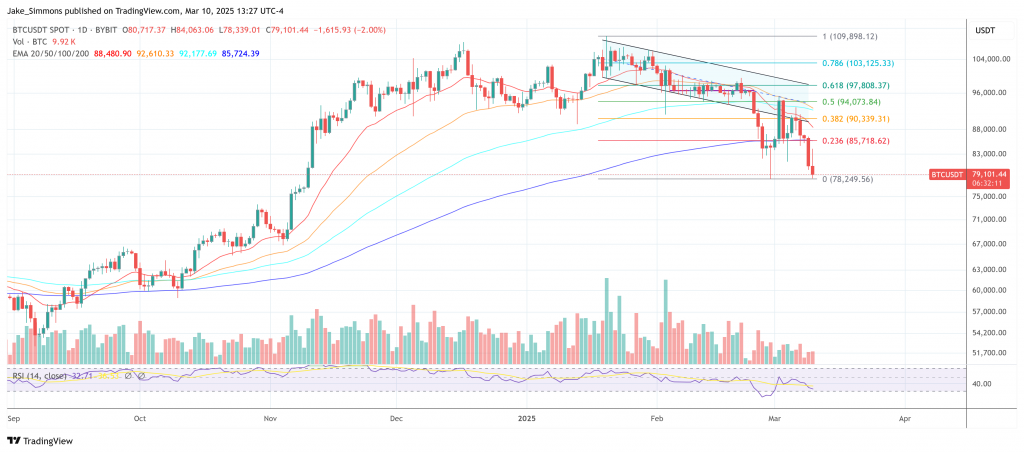
The crypto market is experiencing a significant downturn this week, driven by growing concerns over a potential trade war and disappointment surrounding the US government’s crypto reserve plans. A recent interview with President Donald Trump, in which he hinted at the possibility of a recession, has further unsettled investors. Crypto Market Plummets: XRP, Solana, And Cardano Follow Bitcoin’s Downtrend Bitcoin, the flagship cryptocurrency, has fallen nearly 4% in the last 24 hours, dropping toward the $79,000 mark—a level not seen since mid-November. Ethereum (ETH), has taken a more significant hit with a 10% drop toward $1,860, price not seen since August.  Other established cryptocurrencies are also feeling the strain; XRP has declined by 4%, Solana (SOL) by 7%, and Cardano (ADA) by 8% as market participants continue to retreat from riskier assets. The backdrop to this volatility includes the continuous aggressive tariff policies imposed by the new President Donald Trump administration towards countries like Canada, China, and Mexico.  Related Reading: Bitcoin Slips Under 200-Day Moving Average – Will The Downtrend Continue? These actions have sparked fears of a trade war, which could exacerbate inflation and increase the cost of imported goods. As a result, investors are gravitating toward safer investments, steering clear of the notoriously volatile cryptocurrency market. In a Fox News interview over the weekend, Trump acknowledged that the aggressive tariff strategy could lead to a recession, describing the country as entering a “period of transition.”  This commentary has raised alarms among investors, particularly as Trump did not rule out the possibility of a recession occurring this year. Jake Ostrovskis, an over-the-counter trader at Wintermute, noted that the former president emphasized the likelihood of “short-term economic pain,” amplifying market anxieties. Diminished Risk Appetite And Fed Rate Outlook Adding to the uncertainty is the recent letdown regarding the White House’s plans for a national crypto reserve. Many in the crypto community had anticipated that Trump’s proposal would involve substantial government purchases of Bitcoin and other cryptocurrencies, potentially stimulating demand and boosting prices.  However, investors were disappointed when it was revealed that the government would refrain from making additional crypto purchases and would only retain cryptocurrencies seized from illegal activities. Haider Rafique, the global chief marketing officer at crypto exchange OKX, expressed disappointment in the lack of immediate buying pressure from the formalization of a Bitcoin reserve.  “While establishing a Bitcoin reserve is a significant milestone, it does not create immediate buying pressure, disappointing those expecting aggressive accumulation,” Rafique stated. Related Reading: Dogecoin To $2 Could Be Next If DOGE Holds This Level: Analyst This downturn in the crypto market also follows a broader trend of declining risk appetite among investors. Since the Federal Reserve announced in December that it would not implement as many interest rate cuts in 2025 as previously anticipated, the crypto market has lost approximately 25% of its total market cap.  The optimistic outlook that many had following Trump’s election in November has quickly turned sour, as macroeconomic factors weigh heavily on the market. Featured image from DALL-E, chart from TradingView.com 

What was the biggest Fail you wisely AVOIDED in Crypto?

What was the biggest Fail you wisely avoided in Crypto? For me I was talking with my neighbor at our community pool. He was reading a book on Crypto so we started talking. He said he was big into Cardano, CRO, Jasmy and most heavy into FTX. He said theres no way FTX will ever…
Read more

Fold Adds 475 Bitcoin, Joins Top 10 U.S. Public Companies by BTC Holdings

Bitcoin financial services firm Fold Holdings has added 475 BTC to its treasury, bringing total holdings to over 1,485 BTC. This move solidifies its position among the top 10 U.S. public companies with the largest bitcoin reserves. Fold Expands Bitcoin Treasury to 1,485 BTC Fold Holdings, the first publicly traded bitcoin-native financial services company, has […]

Australian Libertarian Party Unveils Bitcoin Reserve Plan: Will BTC Surge?

The Libertarian Party of Australia has formally unveiled its new Bitcoin Policy Whitepaper, with a centerpiece proposal advocating for the establishment of an Australian Strategic Bitcoin Reserve (SBR). The announcement was made on March 8 during the BitcoinAlive event. The event showcased the Libertarian Party’s vision for integrating Bitcoin into Australia’s financial and regulatory framework. While the party remains relatively small compared to the nation’s two major political contenders, it aims to influence broader debate on crypto policy. This stance places Australia alongside various US states that are working toward legislative recognition of Bitcoin reserves, as well as the US federal government’s announcement last week. Establishing An Australian Strategic Bitcoin Reserve One of the most prominent features of the Whitepaper is the call to create an Australian Strategic Bitcoin Reserve. Referring to Bitcoin’s “decentralized and limited-supply nature,” the Libertarian Party states that: “Bitcoin’s fixed supply of 21 million coins ensures that its scarcity protects against inflation […] This robustness enhances its appeal as a reliable store of value and positions it as an ideal component of Australia’s financial strategy.” Related Reading: Bitcoin Plays Chicken With Central Banks As Dollar Falls, Says Expert The proposal suggests that such a reserve would hedge against inflation, diversify national assets, and “strengthen the nation’s financial resilience.” According to the document, funding would derive from several possible sources, including allocations from Australia’s Future Fund, budget surpluses, and proceeds from government asset sales. Throughout the 23-page White Paper, a repeated theme is that of personal and financial autonomy—concepts foundational to Bitcoin’s decentralized ethos. One recommendation asserts the right to self-custody, arguing that individuals should be able to hold Bitcoin themselves without reliance on central intermediaries. It reads: “The right to self-custody is paramount for achieving true financial sovereignty and privacy in an increasingly digitized economy.” The paper’s authors contend that self-custody protects against “governmental overreach,” referencing past global financial crises that eroded public trust in centralized institutions. Beyond the reserve, the White Paper advocates for comprehensive legal recognition and clearer regulatory standards. It calls for the removal of Capital Gains Tax (CGT) on everyday Bitcoin transactions and outlines a vision in which Australia “positions itself at the forefront of global innovation in financial services.” To that end, the document also proposes: “Treating Bitcoin as a legitimate and viable alternative to traditional financial systems, promoting financial autonomy and inclusivity.” Related Reading: This Bitcoin Signal Aligns With Price Tops, CryptoQuant Analyst Reveals Such moves, the party believes, will encourage further Bitcoin adoption by eliminating “punitive taxation measures” that hamper everyday transactions. Additionally, the White Paper highlights how countries like Germany, Portugal, and Japan have already taken steps to clarify taxation and legal status for Bitcoin users and businesses. Another point of emphasis is fair treatment of Bitcoin mining. Recognizing mounting concerns about energy usage, the policy encourages the integration of mining with renewable or “stranded” energy sources to stabilize power grids and reduce environmental impact: “Bitcoin mining should not be subject to regulations that disproportionately affect the industry. Any regulatory measures must be technology-neutral and focused on broader market stability, grid integrity, and environmental standards.” According to the Libertarian Party, these approaches can help Australia avoid the pitfalls seen in other jurisdictions—such as China, where an outright mining ban led to significant industry disruption. Reactions to the Libertarian Party’s announcement have been mixed. An Australian Bitcoiner remarked: “As an Australian the Libertarian Party is relatively new outside the big two party’s, they won’t get double digits of the vote when the election is finally held. The two majors have no BTC policy that I know of & we really are a backwards country—I won’t hold my breath for any either.” Thus, no immediate impact on the BTC price can be expected. At press time, BTC faced further downward pressure and traded at $79,101. Featured image created with DALL.E, chart from TradingView.com

Tether’s USDT Gains Regulatory Greenlight From Thailand’s SEC

Thailand’s Securities and Exchange Commission has officially approved Tether’s USDT as a recognized cryptocurrency, allowing its trading and potential use in payments, marking a significant step forward for stablecoin adoption in Asia. Thailand Approves Tether’s USDT, Paving Way for Stablecoin Payments Tether’s USDT, the world’s largest stablecoin by market cap, has been officially approved by […]

Solana revenue slumps 93% from January high after memecoin bubble bursts

Solana network revenue and total value locked onchain have collapsed in the past two months as interest in memecoins has continued to taper off. Weekly network revenue on the Solana blockchain hit a record high of $55.3 million in mid-January amid the height of the memecoin minting frenzy. However, revenue has since tanked 93% to around $4 million in the past week, back to levels not seen since September, according to DefiLlama data. Solana weekly decentralized application (DApp) revenue has also slumped around 86% from $238 million in mid-January to $32 million for the past week.  Meanwhile, DeFi total value locked on Solana has also declined by almost 50% over the same period, falling from a January high of just over $12 billion to current levels of around $6.4 billion. Solana weekly revenue and TVL. Source: DefiLlamaMemecoin trading, primarily on the Pump.fun platform comprises roughly 80% of the Solana blockchain’s revenues, according to a March 5 report by VanEck. Pump.fun daily revenue hit a peak of $15 million in late January but has since slumped by around 95% to $800,000 on March 7, according to data from Dune Analytics. Memecoin mania peaked when Donald Trump launched his own namesake token (TRUMP) on Jan. 18, shortly followed by his wife, Melania, who launched MELANIA on Jan. 20.“The launch of TRUMP and MELANIA marked the top for memecoins as it sucked liquidity and attention out of all the other cryptocurrencies,” said CoinGecko founder Bobby Ong on March 6. Both tokens surged following their launches but dumped in the days that followed. TRUMP is currently down 86% from its peak, trading at $10.50, while MELANIA has collapsed 95% in just seven weeks to $0.71.Related: Solana down 45% since Trump token launch as memecoins divert liquidityMemecoin market cap hit a peak of $137 billion in December but has since tanked 68% to $44 billion, according to CoinMarketCap. Memecoin market cap meltdown. Source: CoinMarketCapSolana (SOL) prices have also taken a battering over the past few weeks, resulting in a 58% fall from their mid-January all-time high of $293. The asset was down a further 5% on the day, trading at $122 at the time of writing. Magazine: Bitcoin’s odds of June highs, SOL’s $485M outflows, and more: Hodler’s Digest