

MetaMask Sets Record Straight: No Tax Collection On Crypto Transactions
submitted by /u/CappucinoAtDawn [link] [comments]
submitted by /u/CappucinoAtDawn [link] [comments]

Cointelegraph analyst and writer Marcel Pechman explains how and why the U.S. Treasury is quickly running out of cash, and what that means for Bitcoin and the crypto market.

Shiba Inu (SHIB) found itself in a tight spot as it continued to struggle beneath a significant resistance level. Despite the hopeful anticipation of a bullish reversal, the lack of trading volume acted as a hindrance, dampening the prospects for an upward breakthrough. As SHIB enthusiasts anxiously awaited a potential turnaround, the resistance level posed a formidable challenge, emphasizing the need for increased market participation to fuel a successful climb. Amidst the hurdles of resistance and wavering market conditions, the question arises: Will Shiba Inu defy the odds and make a decent recovery? Related Reading: Ethereum Whale Resurfaces After 2-Year Hiatus, Stakes $7.4 Million In ETH Shiba Inu Struggles To Break Resistance As Bearish Sentiment Prevails Since May 6, SHIB has been locked below the crucial resistance level of $0.00000980, creating a stagnant trading environment. Surprisingly, sellers have been unable to drive prices any lower, while the bulls have failed to mount a significant rally. When compared to the gains made by market leaders in cryptocurrency like Ethereum and Bitcoin during the same time period, Shiba Inu is down by more than 40% from its February high. As of the latest update, the SHIB token is currently valued at a mere $0.00000855 via CoinGecko, highlighting its status as a micro-investment opportunity. Unfortunately, over the past 24 hours, SHIB has experienced a moderate decline of 2.8%, raising concerns about its short-term prospects. This downtrend has persisted for a week, resulting in a 2.2% overall decline. Nevertheless, there are signs that the bearish dominance may be losing its grip as the price approaches a crucial support level at $0.00000807. This presents a potential opportunity for the bulls to stage a comeback and regain control over the market sentiment. Investors and traders eagerly watch this key support level to gauge the next potential move for the Shiba Inu token. Lack Of Volume: A Major Hurdle For SHIB’s Bullish Reversal The potential for a bullish reversal in the Shiba Inu token hinges on one crucial factor: increased trading volume. Without a significant surge in trading activity, SHIB struggles to gain the momentum necessary for a bullish turnaround. Traders and investors keenly await a boost in volume as it could potentially signal a shift in market sentiment, potentially propelling SHIB towards its near-term target of $0.00000980. SHIB market cap at $5.2 billion. Chart: TradingView.com Related Reading: Shiba Inu Sees Juicy Capital Inflows – An Imminent Rebound in Sight? Competing Meme Coins Stealing The Spotlight Adding to the challenges faced by SHIB’s bullish reversal aspirations is the growing trend of market speculators gravitating toward newer meme-based tokens. Memes have become a prominent theme within the cryptocurrency space, with tokens like Pepe (PEPE) and Floki Inu (FLOKI) gaining considerable attention and attracting a significant portion of market participants. The allure of these alternative meme tokens diverts attention and investment away from SHIB, making it more difficult for the token to gather the necessary support and volume to initiate a bullish upswing. While the current market conditions present challenges, SHIB enthusiasts remain hopeful for a surge in volume and renewed investor interest that could ignite a much-awaited rally. -Featured image from Shibainu.berry Instagram/BuzzFeed
So this is something I recently realized recently when looking at the Ledger + Hardware wallet security discussion. When we look at other wallets such as Trezor etc., even if they have open-source, audited and battle tested Software+firmware and bug bounty programs, some "minor" problems always remain. You never know, how many bugs are still…
Read more
Following a recent update, over $120 million of Aave v2, a decentralized finance (DeFi) protocol for lending and borrowing tokens, user assets are “stuck” on Polygon. Bug On Aave v2 On Polygon The bug affecting withdrawals from Aave v2 deployed on Polygon, an Ethereum side-chain, has been pinned to the recent implementation of “proposal 224”. Proposal 224 sought to make parameter changes “for the benefit of the protocol” in light of “shifts in the crypto market .” The adjustment received majority support and was implemented. However, after the execution, the DeFi protocol was notified of several issues affecting the interest rate strategy contracts applied to the wrapped versions of Bitcoin, Ethereum, MATIC—the native currency of Polygon, and USDT—the world’s most liquid stablecoin. Related Reading: Gas Crisis Averted: NFT Marketplaces Witness Dramatic Reduction in Ethereum Fees The development team has said the root cause was because the updated version, especially relating to the “LendingPool to call the rate strategy of an asset” applied on Polygon, was slightly different from that integrated with Ethereum. While users can’t withdraw assets, the DeFi protocol emphasizes that all funds are safe. Beyond the explainer released by Aave, analysts pin the specific problem on the incompatibility issue between the ReserveInterestRateStrategy contract and the underlying Polygon network. Since the contract was designed to work specifically on Ethereum, as Aave mentioned, it couldn’t work on Polygon, causing it to fail. Subsequently, users couldn’t withdraw their tokens. Compatibility Problems The ReserveInterestRateStrategy contract is a core contract in Aave that helps calculate and apply interest rates to borrowed loans. To correctly function, the autonomous contract factors in several things, including prevailing market forces, the risk of user defaulting, and the collateralization ratio. In Aave, all loans are overcollateralized, meaning a borrower must commit more collateral than the amount they wish to borrow. Related Reading: Ethereum Price Remains Range Bound As Bulls Await The Next Major Move The Aave team plans to fix the bug, subject to the result of the ongoing vote. Though the community wants the problem to be fixed, affected users will only begin withdrawing assets from Aave v2 later this week. Considering governance times, if approved, the fix will be applied in approximately seven days from now: 1 day of delay to start voting, three days of voting, one day of time lock on Ethereum, and two extra days of time lock on Polygon. Despite the flaw, AAVE prices are stable. However, since the problem was first brought to light on May 19, the token has been lower but inside the bull bar of May 17. It is yet to be seen how prices will react in the course of the week. Presently, the token is down 25% from April 2023 and remains in a bearish formation. Feature Image From Canva, Chart From TradingView
Even in the face of a bear market, innovation haven't slowed down. 1️⃣ First up, Bengaluru-based startup, Pyor, has successfully raised $4M in seed funding led by Castle Island Ventures. Pyor aims to enhance decision-making infrastructure for digital assets, with a focus on providing high-fidelity data and insights, tailor-made for institutions. Their mission is to…
Read more

submitted by /u/XnoonefromnowhereX [link] [comments]

submitted by /u/user260421 [link] [comments]
Securities Commission Malaysia has ordered Huobi Global to stop all activity after failing to register to operate in the country.
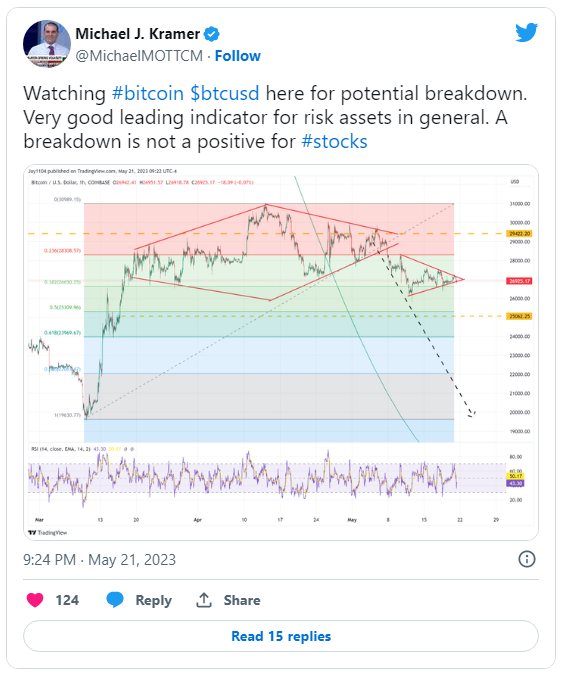
Bitcoin (BTC) has been struggling to regain its momentum as its price remains stuck below the $27,000 mark. This prolonged period of stagnation has prompted Michael J. Kramer, a renowned market strategist, to voice his apprehensions about an impending market breakdown for Bitcoin. Taking to Twitter, Kramer shared his concerns, highlighting the potential risks and uncertainties surrounding the cryptocurrency’s price trajectory. As the cryptocurrency’s value remains inert, it is crucial to examine the factors contributing to this situation and delve into its implications for investors and the broader crypto landscape. Related Reading: Ethereum Whale Resurfaces After 2-Year Hiatus, Stakes $7.4 Million In ETH Bitcoin Price: Concerns Arise Over Potential Slide Below $20K As the cryptocurrency market faces another bout of turbulence, Bitcoin’s price has faltered, with the current value pegged at $26,863, according to CoinGecko. The crypto has lost 2.1% of its value in the last seven days. In his analysis, Kramer not only highlights the potential for Bitcoin to reach the critical psychological level of $20,000 but also draws attention to the implications such a downturn may have on the broader stock market. Source: Coingecko Bitcoin serves as a barometer for other risk assets, providing valuable insights into market sentiment. Should Bitcoin experience a substantial slide below the $20,000 threshold, it could signal increased risk aversion among investors, potentially dampening confidence in the stock market and other asset classes. Regulatory Uncertainty Casts Dark Clouds For Bitcoin Just as analysts eagerly anticipated a potential breakout in Bitcoin’s price, the cryptocurrency market took an unexpected turn, descending into a period of decline fueled by heightened regulatory uncertainty. Despite initial optimism, the prevailing macroeconomic climate and regulatory challenges have conspired to dampen the prospects of a significant price surge in the near term. Analysts had speculated that Bitcoin could experience an influx of investment if the United States were to default on its debt obligations. However, this potential scenario carries substantial risk, as there is a real possibility that the US Treasury may face a shortage of funds. The implications of such a liquidity crunch could be felt across the crypto space, impacting the overall demand and sentiment for digital assets. BTCUSD still stuck in the $26K territory. Chart: TradingView.com Related Reading: Shiba Inu Sees Juicy Capital Inflows – An Imminent Rebound in Sight? Volatility Expected To Persist Adding to the market’s woes, Democrats in the United States legislature have taken steps to solidify the Securities and Exchange Commission’s (SEC) authority over cryptocurrencies. This move has raised concerns that a significant number of tokens may be classified as securities, potentially subjecting them to stricter regulations. The prospect of increased regulatory scrutiny looms over the crypto market, injecting an element of uncertainty and caution among investors and industry participants. In light of these developments, the volatility that has long characterized the crypto market is likely to persist. -Featured image from Pixabay