Category: Cryptocurrency News

Cryptocurrency News and Public Mining Pools

Ethereum Encounters Resistance At Critical Level, Vital Trading Levels to Monitor

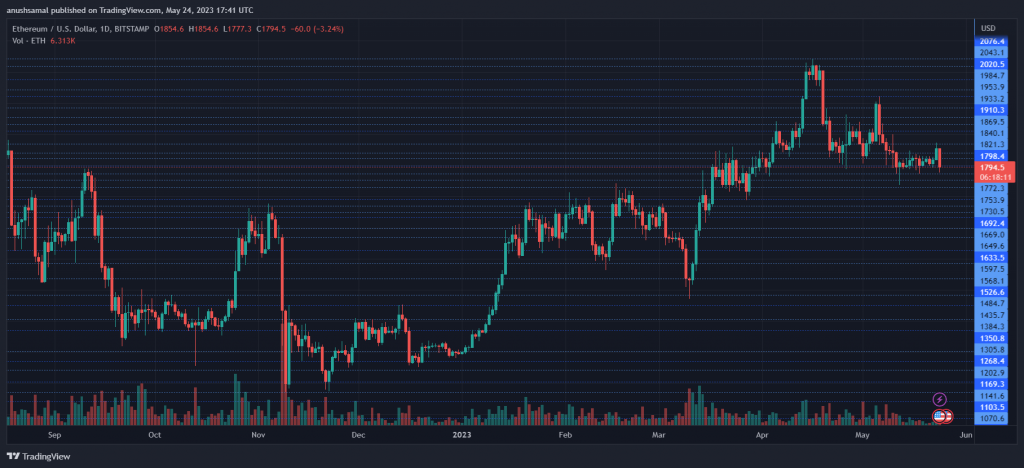
Ethereum started the week with a promising performance, experiencing a gain of over 3%. However, the bullish momentum was short-lived as the altcoin failed to sustain its position above a key resistance level. Within the past 24 hours, ETH’s market value has declined by nearly 3%. Throughout the week, the ETH price has shown limited progress, with the bears dominating the price movement. The altcoin’s technical outlook indicates a decline in buying strength, accompanied by low demand and accumulation on the daily chart. Related Reading: Ethereum Staking Hits Over $40 Billion After Shanghai Upgrade: What It Means For ETH To prevent further strengthening of the bears, it is crucial for Ethereum to surpass its immediate resistance in the upcoming trading sessions. Failure to do so may lead to additional pressure from sellers, potentially causing Ethereum to breach its immediate support level and experience a significant loss in value during future trading sessions. Additionally, the fall in the ETH market capitalization suggests an increase in selling strength, as observed on the daily chart. Ethereum Price Analysis: One-Day Chart At the time of writing, the trading price of ETH was $1790. Despite attempting to trade within the $1800 price range, the altcoin encountered selling pressure, resulting in its depreciation. The current overhead resistance for Ethereum is $1810. If the altcoin surpasses this resistance level, it has the potential to trigger a rally in its price. On the other hand, if the present price level experiences a decline, Ethereum is likely to decline further to $1750 before eventually reaching the $1700 price mark. The recent session saw a decrease in the volume of Ethereum traded, indicated by the red colour, indicating a weak buying strength. Technical Analysis Throughout this month, Ethereum experienced a decline in demand, resulting in reduced buying strength. The Relative Strength Index (RSI) dropped below the midpoint line, suggesting a decrease in demand and an increase in selling pressure on the chart. Additionally, the price of Ethereum fell below the 20-Simple Moving Average (SMA), indicating that sellers were dominating the market’s price momentum. Given that Bitcoin’s price movement remains uncertain, several altcoins, including Ethereum, have followed a similar price trajectory. However, if Ethereum gains broader market strength, there is a possibility that demand could return, causing ETH to surpass the 20-SMA line and potentially climb higher. Due to the absence of demand, ETH did not exhibit significant buy signals. The Moving Average Convergence Divergence (MACD), a tool used to indicate price momentum and potential trend reversals, showed small green histograms that do not provide conclusive buy signals at this point. The Bollinger Bands, which measure price volatility and potential fluctuations, have maintained a parallel shape. However, they displayed slight convergence, suggesting that ETH may trade within a relatively stable range without substantial price fluctuations. Related Reading: Bitfinex And Crypto Bank OrionX Forged Partnership To Broaden Presence In Latin America To reclaim the $1800 price level, it is crucial for buyers to re-enter the market at the current price level. Their participation is essential for Ethereum to regain strength and potentially push the price higher. Featured Image From UnSplash, Charts From TradingView.com

The Bitcoin Rollercoaster: Why Every Upward Move Is Followed By A Steep Drop?

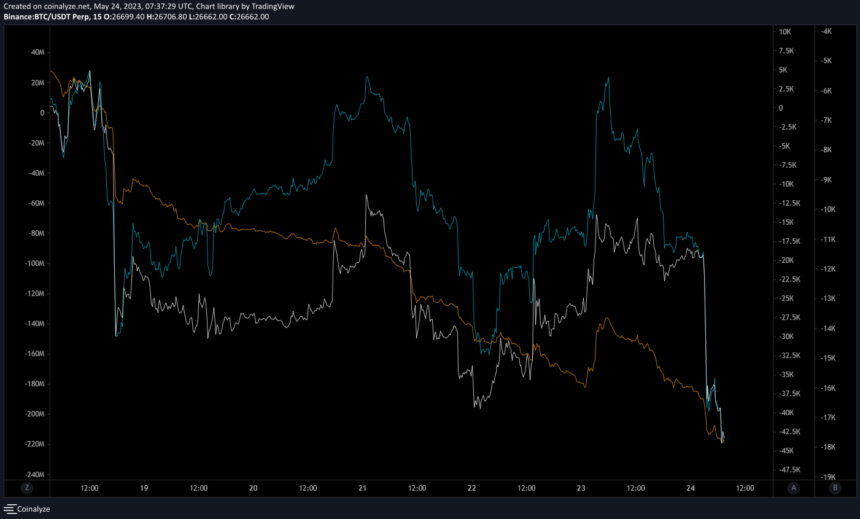
Bitcoin (BTC) has failed to hold onto gains over the past few weeks, giving back nearly all price increases shortly after they are made. According to crypto analyst and trader Daan Foppen, this phenomenon can be attributed to the outsized influence of futures markets on Bitcoin’s price action. Foppen notes that Bitcoin’s spot market, where investors buy and sell actual BTC, has been mainly selling recently, as evidenced by the downtrend in spot market prices. In contrast, moves upward in Bitcoin’s price have been driven primarily by activity in futures markets, where traders speculate on the future price of BTC using leverage. Related Reading: Crypto Market Alert: Tether Market Cap Fuel Hopes For Major Rally Bitcoin’s Downward Spiral Continues “The moves that are made are mostly made with borrowed money, and these kinds of things are not sustainable for a market,” says Foppen. Whether stablecoin-margined or coin-margined, futures markets have been the driving force behind short-term price impulses in Bitcoin recently. However, the buying power used to move prices upward ultimately evaporates, leading to gains to be given back. When futures dominate trading, the underlying spot market struggles to keep up. Price gains outpace actual buy demand for Bitcoin, leaving the market susceptible to abrupt reversals once futures buying power subsidies. This concept has been displayed clearly on Bitcoin price charts over the past month, with initial price spikes evaporating quickly. Furthermore, according to Daan Foppen, recent volatility and price reversals in Bitcoin have been driven largely by leveraged trading and liquidations in futures markets. Foppen argues that the cryptocurrency’s price action over the past several weeks has been characterized by “impulsive moves” upward and downward that seem forceful but lack strength and sustainability. For example, Bitcoin’s move to $27,400 on May 23 was mainly fueled by short liquidations, as overleveraged short positions were wiped out, creating a “snowball effect” upward. The subsequent sharp drop was similarly driven by the liquidation of long positions that had opened during the consolidation period with the expectation of higher prices. BTC’s Increased Leveraged Positions Moreover, Foppen points out that interest in Bitcoin futures has risen, indicating increased leveraged trading activity. However, it is difficult to determine whether new positions are predominantly short or long. Funding rates, which indicate whether longs or shorts are paying interest to balance the market, have been slightly positive recently but remain around the baseline. Still, Foppen believes the ingredients are in place for “a deeper flush downwards” in Bitcoin’s price due to the likelihood that recently opened positions are mainly longs. “What you shouldn’t do now is blindly click the short button,” he warns.  With highly leveraged and unstable dynamics currently driving Bitcoin’s price action, Foppen cautions that these are “very shaky conditions,” protecting one’s capital should be the top priority for traders. “What you should especially not do is let yourself get chopped up in this market,” he says.  Related Reading: Ethereum Staking Hits Over $40 Billion After Shanghai Upgrade: What It Means For ETH As of this writing, BTC is trading at $26,200, down over 3% in the last 24 hours. However, the largest cryptocurrency in the market may potentially stop its potential continuation of the downtrend at the 200-day Moving Average placed at $24,900, which may serve as a threshold for bulls.  Featured image from iStock, chart from TradingView.com 

Unciphered BREAKS the Trezor T!!!

Unciphered BREAKS the Trezor T!!! submitted by /u/ShinAlastor [link] [comments]

Wallet address

Does anyone know who’s the owner of this address? 0xBaeD383EDE0e5d9d72430661f3285DAa77E9439F submitted by /u/skdidjsj [link] [comments]

Gate Group launches new virtual asset trading platform in Hong Kong

As of May 23, users can deposit and withdraw virtual assets and participate in spot trading activities.

ZA Bank plans digital asset retail trading in Hong Kong under new guidelines

The bank announced its plans, part of its diversification strategy, the day after Hong Kong released its new guidelines.

Bitcoin price hangs in the balance — Friday’s $2.26B BTC options could result in more downside

Bitcoin bears benefit from the current macroeconomic uncertainty and are aiming for a $270 million profit if the BTC price falls below $25,000.

Down But Not Out: The One Line Bitcoin Must Hold To Be Bullish

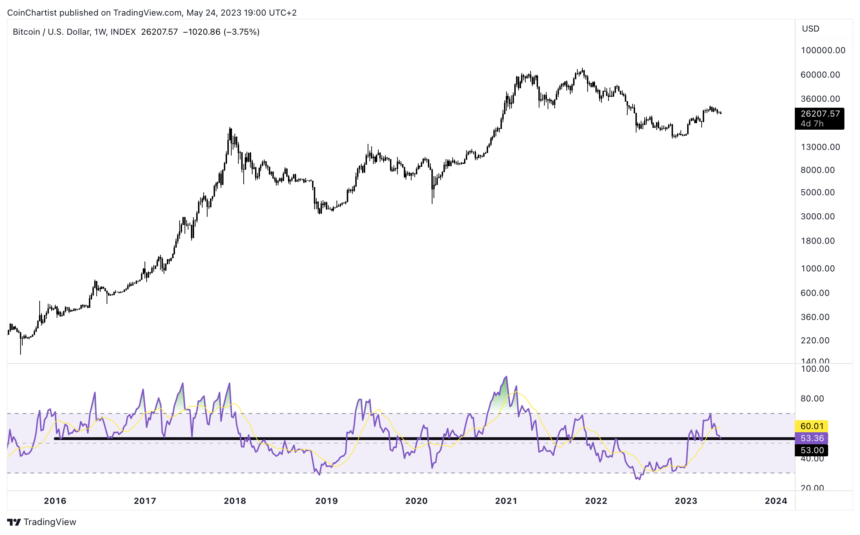
Bitcoin price is falling, testing the low $26,000 area of support after weeks of painful, sideways consolidation. While the horizontal support line is clearly important, it’s nowhere near as critical as another line that BTCUSD absolutely must hold to remain bullish. Drawing Trend Lines In Bitcoin Technical Analysis In the practice of technical analysis, drawing trend lines is among the first basic steps anyone will take. Simply connect the line across various points on the chart to highlight support and resistancesupport and resistance. Another basic step involves turning on technical indicators to look for potential buy and sell signals. Some of these tools call out when an asset is overbought or oversold, such as the Relative Strength Index. Related Reading: Bitcoin Price Double Fractal Points To “Extended” Parabolic Rally More advanced techniques include drawing trend lines on indicators like the RSI instead of price. Much like drawing these lines from point to point diagonally can plot uptrends or downtrends, horizontal lines can also act as support or resistance on the RSI. On the weekly timeframe Bitcoin price has pulled back to a reading of 53 on the RSI. This level must hold, according to past price history. Each time it has, the crypto market has erupted higher. Holding the line is imperative | BTCUSD on TradingView.com Bulls Must Show “Strength” At Current Levels The above BTCUSD weekly chart shows the RSI pulling back to a reading of 53. The last time this happened, was in Q3 2020 right before an epic bull run. The short bullish rally in 2019 blasted right through it without a retest of the level. Prior to these instances, all other outcomes were shockingly bullish when Bitcoin held above the line. Rather than falling into a bearish phase, each time BTCUSD weekly RSI held at the line in 2016 and 2017, the crypto market simply marched higher. Related Reading: This Bitcoin Indicator Turned $5 Into $34,000 Other times, when BTCUSD failed to hold this line, a bear market ensued. A failed attempt to get back above the level typically led to the last leg of the bear market. However, getting back above it and then failing to hold could provide the crypto market with something more reminiscent of the COVID collapse and is something to watch closely for. Hold the line, and bulls will run again, possibly to new all-time highs. https://twitter.com/tonythebullBTC/status/1661464701853745152 Tony is the author of the CoinChartist (VIP) newsletter. Follow @TonyTheBullBTC & @coinchartist_io on Twitter. Or join the TonyTradesBTC Telegram for exclusive daily market insights and technical analysis education. Please note: Content is educational and should not be considered investment advice. Featured image from iStockPhoto, Charts from TradingView.com

Crypto Market Alert: Tether Market Cap Fuel Hopes For Major Rally

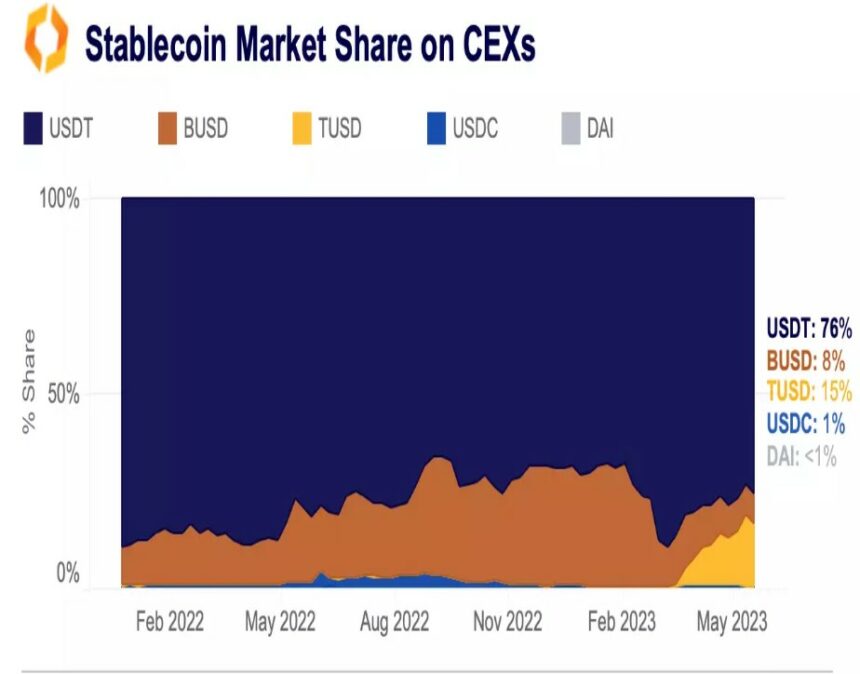
Despite lackluster trade volume and price movements in the cryptocurrency market, Tether’s market cap is rising, nearing its all-time high of $82.9 billion. Tether, also known as USDT, is a stablecoin pegged to the U.S. dollar, making its value more stable than other cryptocurrencies. Related Reading: Bitcoin Sell-Side Risk Ratio Nears All-Time Lows, Big Move Soon? USDT’s Explosive Growth The question remains: why is Tether’s market cap increasing despite the lack of strong movements in the cryptocurrency market?  According to the research firm Kaiko, one theory is that the imminent end of BUSD, another stablecoin, and Circle’s USDC March de-pegging event caused traders to rotate into USDT. However, data does not show a significant increase in USDT market share relative to other stablecoins in recent months. Another possible reason for Tether’s market cap increase is Binance’s promotion of TUSD as an alternative to BUSD. This move may have caused traders to move away from BUSD and towards other stablecoins, including USDT. On decentralized exchanges (DEXs), USDT accounts for just 20% of non-stablecoin swap volume, an increase since the start of the year, but not enough to explain the more than $15 billion increase in market cap over the same period. While the March banking crisis saw a large rotation of capital into USDT, the actual usage of the stablecoin on both centralized and decentralized exchanges suggests that the increase in market cap is “inordinate”, according to Kaiko. Furthermore, one possible explanation for Tether’s climbing market cap could involve the Tron network. Most of all, USDT, or $46 billion worth, are issued on Tron, compared to just $36 billion on Ethereum. Despite Tron’s minimal decentralized finance (DeFi) activity and the lack of support from major exchanges like Coinbase, offshore exchanges such as Binance and OKX possess the largest USDT balances on Tron. This suggests that market makers and whales prefer Tron for its low transaction fees. In contrast to Tether’s market cap, USDC’s market cap correlates with trade volume. As USDC volume grows, the market cap increases similarly, and vice versa. USDT’s market cap, however, has little correlation with trade volume, which is questionable given that the primary use case for this stablecoin is trading. Large Tether Movements Raise Questions About Market Stability According to Whale Alert on Twitter, there have been several large movements of Tether’s stablecoin, USDT, in the cryptocurrency market in the past three hours. These movements suggest a significant transfer of funds, with implications for the broader market. First, an unknown wallet transferred 50 million USDT, or $50 million, to Bitfinex, a popular cryptocurrency exchange. This was followed by Kraken, another leading exchange, transferring 60 million USDT, or $60 million, to Bitfinex. Lastly, Tether Treasury, the issuer of USDT, transferred 60 million USDT to Bitfinex. Additionally, 50 million USDT was transferred from JustLendDAO to an unknown wallet. The movements of these large sums of money suggest that significant trading or investment activity may occur on Bitfinex, one of the largest cryptocurrency exchanges. These transfers may be related to a large purchase of cryptocurrency or a significant investment by a hedge fund or institutional investor. Related Reading: Ethereum Staking Hits Over $40 Billion After Shanghai Upgrade: What It Means For ETH Overall, the implications of these movements for the broader cryptocurrency market remain uncertain. However, given the size of the Tether transfers, it is possible that they could impact the market’s overall stability and could lead to a surge or decline in cryptocurrency prices. Featured image from iStock, chart from TradingView.com 

Coinbase's Base network publishes 'path to mainnet' outlining roadmap

The testnet must perform the Bedrock upgrade and go through audits and stability tests before mainnet launch.